China and the World Program 20th Annual Conference | Panel 2: Foreign Policy Implications of the PRC’s Economic Slowdown
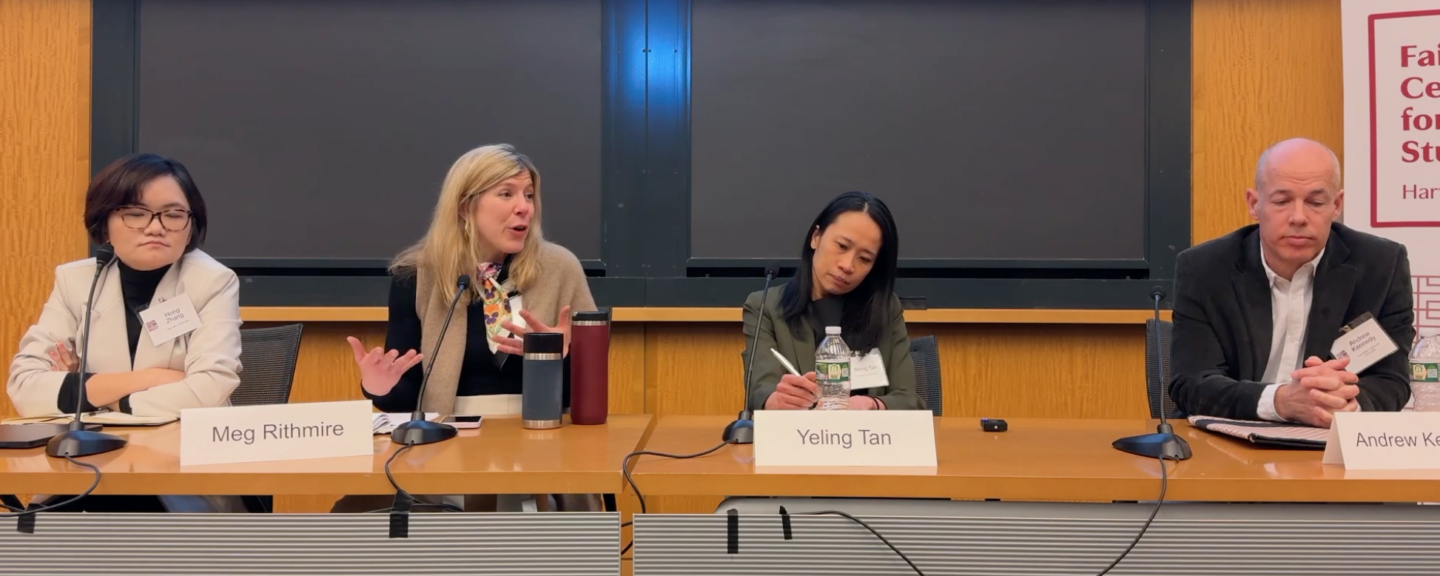
Does China’s slowdown signal crisis or a deliberate rebalancing? Would either reshape Beijing’s external behavior? Yeling Tan (University of Oxford), Hong Zhang (Harvard Kennedy School), and Andrew Kennedy (Australian National University) discuss the foreign-policy consequences of China’s economic readjustment. Tan focuses on how China’s economic shift towards high-tech self-sufficiency and away from consumption-driven growth is being filtered through a lens of national security. Zhang examines China’s engagement with developing nations, noting a shift toward more sophisticated forms of mercantilist expansion. Kennedy outlines China’s focus on a state-led effort to steer the national innovation system toward self-reliance, emphasizing that the anticipated impact on global economic interdependence is ambiguous.
Discussion moderated by Meg Rithmire (Harvard Business School).
第二場:中國經濟放緩的外交政策影響
中國經濟放緩,究竟是積重難返的危機徵兆,抑或是審時度勢的主動調整?無論何者,是否都將促使北京重新布局其對外行為?牛津大學的譚葉凌(Yeling Tan)、哈佛肯尼迪學院的張翃(Hong Zhang),以及澳洲國立大學的 Andrew Kennedy,共同審視中國經濟轉型對外交政策的深遠影響。譚葉凌著重分析中國如何以國家安全為旨歸,推動經濟結構從消費驅動轉向高科技自立自強。張翃則考察中國與開發中國家的往來互動,指出北京已轉向更為精密複雜的重商主義擴張路徑。Andrew Kennedy 則勾勒中國以國家為主導、引領創新體系走向自立自強的戰略圖景,並指出此一走向對全球經濟相互依存格局的影響,至今仍難以定論。
本場次由哈佛商學院商業、政府與國際經濟部門 F. Warren McFarlan 副教授任美格(Meg Rithmire)主持。