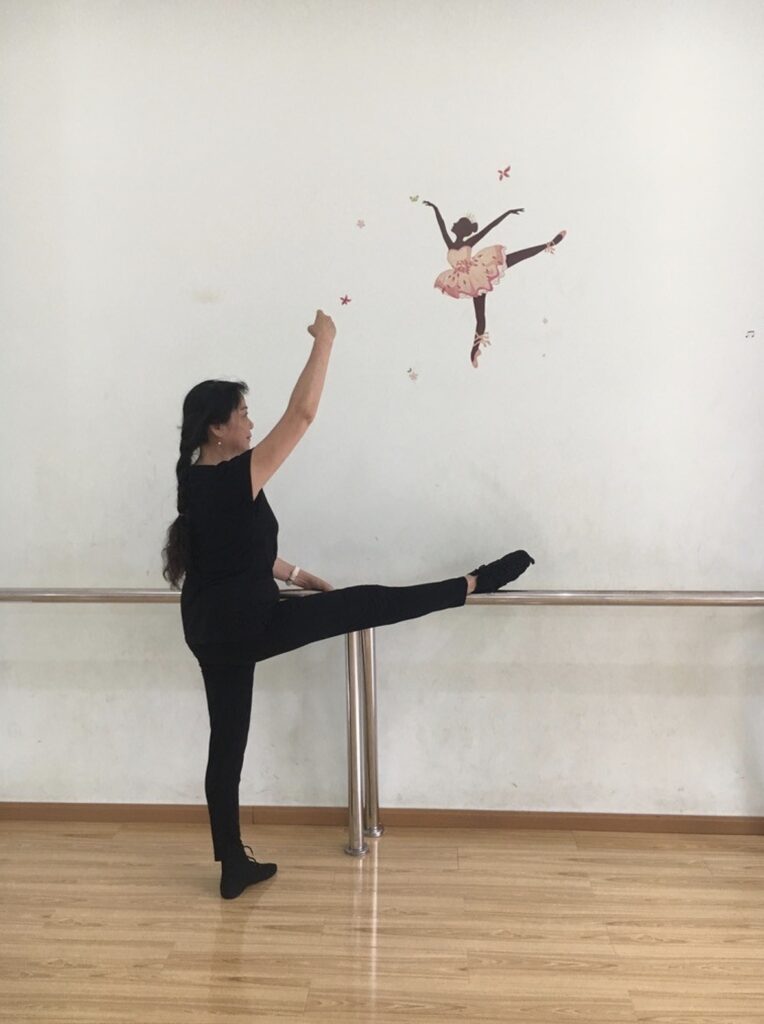
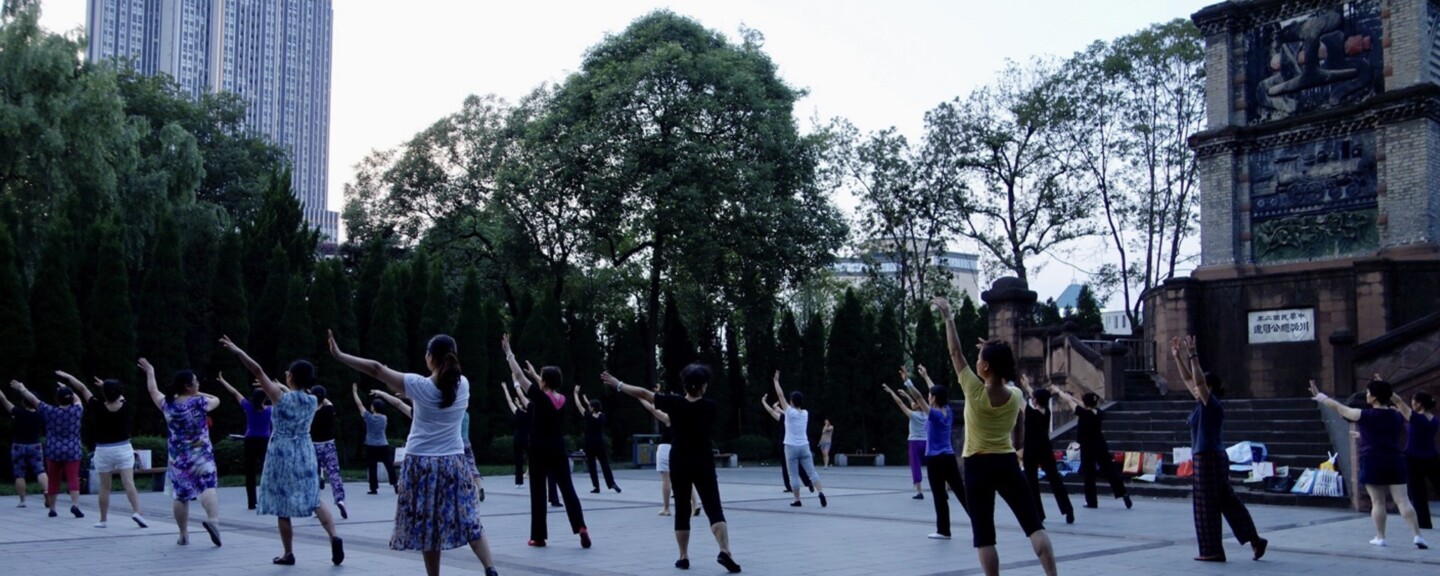

If you’ve ever strolled through a public square in a Chinese city, chances are you’ve encountered the vibrant, music-filled gatherings of the so-called “dancing grannies” (广场舞大妈). But what lies behind the synchronized steps and upbeat music? In her new book, Dancing for Their Lives: The Pursuit of Meaningful Aging in Urban China (Rutgers University Press, 2025), Claudia Huang, Assistant Professor of Human Development at California State University, takes us beyond the spectacle to explore how these retired women use dance to reclaim joy, forge community, and challenge what aging looks like in today’s China. In this conversation, Professor Huang (a 2021-22 An Wang Postdoctoral Fellow at the Fairbank Center) shares insights from her ethnographic research in Chengdu and reflects on how aging, resilience, and everyday resistance intersect in the lives of urban Chinese women. (This dialogue expands on Professor Huang’s Urban China Lecture from the Spring 2025 semester.)
One would hardly miss the “dancing grannies” (广场舞大妈) if they visit contemporary Chinese cities. Your book provides a vivid and enchanting ethnography of them. How does your book contribute to our understanding of this phenomenon and the transformation of China’s urban society?
I think the “dancing grannies” have become as emblematic of contemporary China as high-speed trains and smartphone apps. They’re a whole vibe, as the kids would say. But beyond the portable speakers and the matching costumes is a deeper story about the complex relationship between social change and people’s lived experiences. Dancing for Their Lives is based on several years (combined) of ethnographic research in Chengdu, China. I had two main aims in writing this book. First, I wanted to move beyond thinking about the phenomenon as mere spectacle. I argue that through dancing and socializing, retired Chinese women are not merely filling time, but also reimagining what it means to grow old by reshaping the aesthetics, values, and relationships that define later life. Second, I wanted to complicate popular and scholarly understandings of aging in China, which tend to focus on macro-level demographic changes and policy adaptations. Instead, I foreground aging as a generative process — one that can be a site of social production and transformation. Ultimately, Dancing for Their Lives is about more than dancing or aging — it’s about resilience, creativity, and the quiet revolutions that unfold in everyday life.
Growing old is a challenge that affects us all. The dancing women, often referred to as China’s “lost generation,” create new models and new meanings of lives as they age. Why did they choose to dance?
Aging is a biological inevitability, but for humans, growing older is also a social process. Most people who participate in dance groups belong to a generation that came of age during an incredibly tumultuous period in China’s history. They were born in the years immediately following the Communist Revolution in 1949; they were children during the Great Leap Forward; and they were adolescents or young adults during the Cultural Revolution. Then, just as they were hitting their stride in adulthood, the economic reforms came along and caused massive layoffs among their generational cohort. It’s hard to overstate how much Chinese society has changed during their lifetimes. The social, political, and economic frameworks that define stages of the life course have all been profoundly reshaped. Older Chinese women have few usable scripts for what aging should look like. Traditional roles no longer hold the same authority, and contemporary models of femininity (often driven by ideals about youth and beauty) feel out of reach or irrelevant.
A lot of people dance because they like the music or the movement, but they often also have deeper motivations as well. In the book, I look at how joining a dance group and identifying as a dama (大妈) allows retired Chinese women to create a template for aging that feels both authentic and joyful. The dance groups offer women of this generation a space for self-expression while also providing a sense of social belonging. Few women who participate in dance groups are truly proficient dancers, but the people who make fun of them (and there are many!) are missing the point, I think. It’s not about the dance, per se, but rather about the camaraderie and opportunities for finding self-fulfillment that the dance groups provide. Similarly, the dama persona has a distinctive look that is often the object of derision (The scarves! The giant sunglasses! The penciled-in eyebrows!) The whole thing does come off as a little silly, I admit, but I also think it’s important to remember that the people who adopt it are making a purposeful attempt to re-imagine what it means — and looks like — to grow old.
The women in your book are both inspirational, resilient, cheerful, and unsatisfying, struggling, if not pessimistic. They adopted a blasé attitude about the future in the face of uncertainty, as you depicted in Chapter 4, “Play a Day, Count a Day.” What is the role of the “invisible state” in this book?
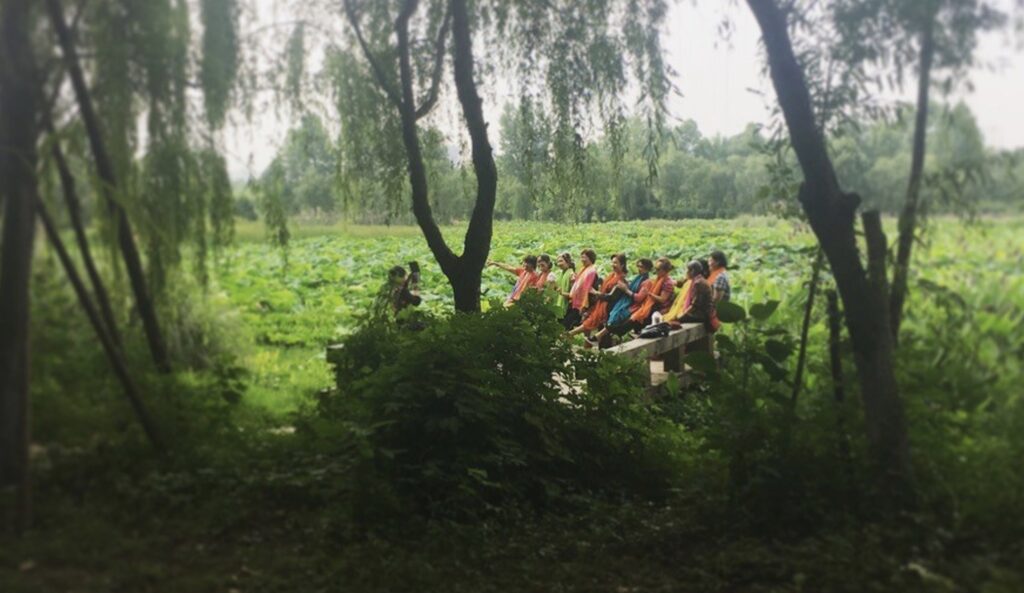
When I began doing fieldwork, I was initially struck by the sheer exuberance of the dance groups. They just look like they’re having so much fun all the time! But after awhile, as I deepened my relationships and conducted more intimate interviews, a darker and more complex story began to emerge. In Dancing for their Lives, and particularly in Chapter 4, “Play a Day, Count a Day,” I explore this tension through the stories of women who, while appearing joyful and carefree, quietly express deep concerns about growing older in the wake of the state’s broken promise to take care of urban workers “from the cradle to the grave.” Many of them spoke to me about the impossibility of aging comfortably with an inadequate eldercare infrastructure and just one child to rely on. Still, rather than dwell on despair, they choose to dance, to play, and to make the most of the present moment. What impressed me most was how these women simultaneously acknowledged and decentered their fears by turning to routines and rituals that allowed them to continue living meaningfully.
The “play a day, count a day” attitude isn’t a form of denial, but rather a strategy. In the absence of meaningful state support or reliable long-term care, many of these women have crafted a way of living that prioritizes joy and community. I came to see this as a sort of improvised resilience.
The role of the state is that of an invisibly present force: the lack, or inadequacy, of policy solutions to China’s oncoming eldercare crisis is the backdrop against which the dama‘s daily decisions are made. In this sense, their dancing isn’t just leisure or performance. It is also a form of critique. Through dance and play, they resist a narrative that casts them as demographic burdens. Instead, they insist — sometimes cheerfully, sometimes bitterly — on the fullness of their lives.
You represent a first-generation of immigrant scholar, one who received higher education in the U.S. while having a close connection to China. You have grown a meaningful academic life navigating through the cultural and linguistic barriers between the two countries. What’s your advice for young scholars like you doing ethnographic fieldwork and qualitative study on China?
I asked my Ph.D. advisor Yunxiang Yan this same question before I began my dissertation fieldwork. I’ll never forget his reply: “Being able to blend in can be an advantage, but it can also be a burden. Don’t assume you’ll automatically get an insider perspective.” He turned out to be right (on this and many other points). On the one hand, the fact that I was able to conduct interviews in the local dialect proved to be helpful since a lot of older people don’t speak Mandarin comfortably. It was also nice to be able to do observations without attracting attention to myself. On the other hand, many people I met during my research — particularly government officials — assumed I had a level of knowledge about policies and practices that I simply did not. They would leave a lot unsaid, and I would have to do extra prodding to fill in the gaps. The other international scholars at my host university didn’t encounter this problem. Because they were foreign by appearance, their interviewees would provide extra context and history without prompting. All this is to say that every researcher will encounter unique challenges and opportunities regardless of her positionality. I think the important thing is to be aware of how our identities may influence how people respond to us, as well as how our perspectives may shape the way we approach our research to begin with.