
- This event has passed.
Film Screening – Too Loud for the State—Chinese Rock n’ Roll on the March: Zhang Yuan’s Beijing Bastards 北京杂种 (1993)
February 18 @ 6:00 pm – 9:00 pm
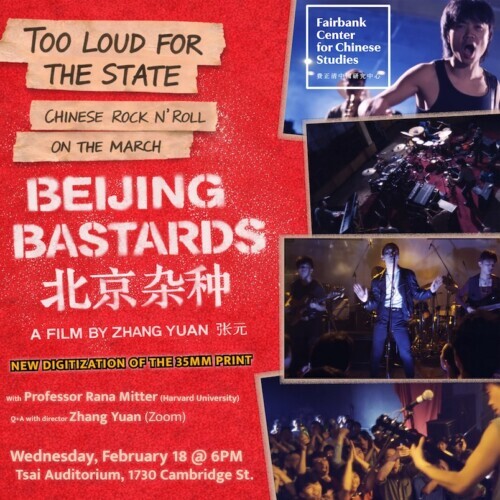
Speaker: Rana Mitter, ST Lee Chair in US–Asia Relations, Harvard Kennedy School
Guest filmmaker (via Zoom Q&A):Zhang Yuan, Director of Beijing Bastards
“Rock music was the only way young people could express what they were feeling.”
—Zhang Yuan
Join us for a special screening of Beijing Bastards (北京杂种, 1993), Zhang Yuan’s raw, unflinching, and influential portrait of China’s underground rock n’ roll scene, filmed amidst a moment of profound cultural rupture in the country’s capital. This screening will be introduced by Professor Rana Mitter (Harvard) and followed by a Zoom Q&A with director Zhang Yuan (张元).
Beijing Bastards is an odyssey through the vibrant, seedy underbelly of Beijing’s bars and hutongs. It features rock icons Cui Jian (崔健) and Dou Wei (窦唯) loosely playing versions of themselves as they gig, drink, fight, and curse their way through torrid summer nights and muddled days. Zhang captures sweltering rehearsal rooms, crowded performance venues, makeshift living spaces, violent clashes, and fleeting moments of intimacy within a milieu that existed largely outside—and often in tension with—the state, the broader society, and its rules.
The film powerfully registers the emotional fallout of post-1989 China, when political expression was pushed into the shadows even as economic liberalization accelerated. In this climate of dashed idealism and uncertain transition, loud and passionate Chinese rock music (yaogun 摇滚) became a precarious outlet for release, dissent, and self-definition. Beijing Bastards documents this subculture with an immediacy that was unprecedented in Chinese cinema.
A restless blur of color, motion, and thunderous sound, Zhang’s film functions simultaneously as musical documentary, as piercing sociopolitical commentary, and as raucous drama. It highlights the destructive behaviors—particularly among men—shaped by alienation, emasculation, and disillusionment. At a moment when China was seeking order and stability, Zhang instead turned his camera toward lives at the margins, portraying them with unvarnished honesty.
Filmed on a shoestring budget and without official permission—making it among China’s earliest crop of independent films—Beijing Bastards was never approved for domestic release. Its international festival screenings in the mid-‘90s brought Zhang global attention but also a multi-year filmmaking ban. Over its history, aside from the occasional celluloid screening, most viewers of the film have had to settle for heavily degraded bootlegs. For this event, we’re proud to present Beijing Bastards in a newly digitized transfer from its original 35mm print—a rare opportunity to experience Zhang Yuan’s zeitgeist-capturing opus in all its audiovisual splendor.
The screening will be preceded by Zhang Yuan’s Beijing Film Academy student film White Lines (白线, 1988), starring painter Liu Xiaodong (刘小东), the film’s first ever public screening.
Rana Mitter is ST Lee Chair in US–Asia Relations at the Harvard Kennedy School. He is the author of numerous books on modern Chinese history, including Forgotten Ally (2013) and China’s Good War (2020). His commentary on China has appeared in Foreign Affairs, The Guardian, and The Financial Times, and he has regularly contributed to BBC Radio and television. He is a Fellow of the British Academy and recipient of the 2020 Medlicott Medal for Service to History.
Zhang Yuan is a pioneering figure in China’s independent film movement and one of the so-called “Sixth Generation” directors. His major films—including Beijing Bastards, Mama, and East Palace, West Palace—challenged official narratives and censorship norms, helping to redefine the possibilities of Chinese cinema in the 1990s. His work has screened widely at international festivals and remains central to discussions of underground culture, sexuality, and subversiveness in contemporary China.