

Gender Studies and Performance Workshop
April 24 @ 9:00 am – 5:00 pm
9:00 – 9:15 AM: Welcome Remarks
9:15 – 10:45 AM: Panel One
Commentators:
Waiyee Li, Harvard University
Thomas Kelly, Harvard University
Eugene Wang, Harvard University
The Woman Inhabiting a Dog’s Body: How Asian Theatre Evolved?
When did Asian theatre begin—and how? I approach this question through a single, startling image: Mulian’s mother reborn as a dog. The Mulian story—of a son descending into hell to rescue his damned mother—circulated as scripture, transformation text, cave mural, Ghost Festival ritual, and eventually full-fledged theatrical spectacle. Its remarkable transmedial persistence demands explanation.
I argue that Mulian functioned as a conceptual engine for theatre’s evolution. The narrative’s internal pressures—how to render hell visible, how to stage karmic punishment, how to embody transformation, how to make filial devotion sensorially overwhelming—forced successive media to innovate. Cave murals developed sequential and topographic pictorial logics; ritual performances mobilized immersive, participatory environments; theatre devised acrobatics, mechanical effects, demonic choreography, percussive soundscapes, and startling audience infiltration.
The episode of “the woman inhabiting a dog’s body” crystallizes this engine at work: grotesque degradation and redemptive love fused into a single theatrical demand. The story did not simply migrate across media—it reconfigured them. Asian theatre, I suggest, emerged not as a sudden invention but as the cumulative response to a narrative that insisted the invisible be made visible, the metaphysical made bodily, and salvation staged before a crowd.
Kangni Huang, University of Southern California, Society of Fellows in the Humanities
The (After)life of a Stele: The Materiality of Writing in Jiang Shiquan’s Three Plays on Consort Lou
This paper focuses on the High Qing dramatist Jiang Shiquan’s 蔣士銓 (1725-1785) three plays on Consort Lou 婁妃, wife of the rebellious Prince Ning, Zhu Chenhao 朱宸濠 (d. 1520). The historical Consort Lou leaves only scarce traces in official history, appearing primarily as a virtuous yet tragic figure whose repeated remonstrations against her husband’s rebellion went unheeded. Meanwhile, Jiang’s theatrical portrayal of this historical figure shapes the image of Consort Lou into a reflexive voice on the issue of writing as material traces. Among the three plays by Jiang, the first two, Yi pian shi 一片石 (A Piece of Stone) and Di’er bei 第二碑 (The Second Stele), tell the rediscovery and commemoration of her burial site over the span of twenty-five years. And the last one, Caiqiao tu 採樵圖 (The Painting of Gathering Wood), stages the rebellion and Lou’s virtuous actions during the turmoil. Building on recent scholarship that defines these works as “metahistorical plays,” my analysis highlights the intricate relationship between Consort Lou’s life story as a virtuous woman and the materiality of writing. It argues that Jiang’s recurring reflection on the precariousness of material texts is deeply intertwined with the constructed image of Lou as both a female author and reader. By recentering on Lou’s authorial and readerly voice in these plays, this study elucidates how theater not only reimagines but also reinvents gender history.
10:45 – 11:00 AM: Refreshment Break
11:00 AM – 1:00 PM: Panel Two
Commentators:
David Der-Wei Wang, Harvard University
Eileen Cheng-yin Chow, Duke University
Nancy Rao, Rutgers University
Opera Actresses in the Cantonese Sojourner Community: From Shanghai to San Francisco
Taking the 1922 encounter in Shanghai between Cantonese opera actress Li Xuefang and Peking opera star Mei Lanfang as a point of departure, this paper argues that Cantonese opera’s rising status then was a reconfiguration of cultural capital across regional and diasporic networks. By analyzing the circulation of the term “Bei-Mei-Nan-Xue” (北梅南雪) and the scholar–gentry–merchant alliances that underwrote both of their prominence, the study demonstrates how operatic prestige was produced through urban modernity and elite patronage. The paper situates Shanghai as a mediating hub in the transpacific cultural economy that linked Cantonese opera to Chinese communities in North America. In this way, opera actresses emerge not only as performers but as agents in the production of diasporic modernity, negotiating gender, regional identity, and transpacific mobility.
Catherine V. Yeh, Boston University
Huashanas the Ideal Modern Women
Between 1910s and early 1920s a group of talented Peking Opera actors, led by Mei Lanfang 梅兰芳and followed by three other great dan actors created a new female role called huashan 花衫,or “flower-shirt.” This was remarked upon at the time by the theater world at large as the main reason for their rise in stardom. Undoubtedly, the new huashan operas attracted large audiences in part because of the novelty of the role, which combined the three main dan roles including the morally upright qingyi 青衣,the coquette sexy huadan and the martial, spirited wudan. In the huadan the audience saw a more rounded female character that seemed to fit the modern standards of realism, while the dynamism expressed in this new role appeared to represent the spirit of the time. Yet, in terms of ideology, this huashan character does not pose a challenge to the Confucian image of the ideal woman. Embedded in each of the three main dan role types is an essentially Confucian view of womanhood. The real formal breakthrough that challenged the standard ideology of ideal womanhood came with the introduction of dance into Peking opera by Mei Lanfang. The re-creation of the lost Chinese dance by him and his adviser Qi Rushan transformed Peking opera aesthetics and its embedded social values. The form itself projected an alternative ideal womanhood that challenged standard gender ideals. At the same time, Mei Lanfang and Qi Rushan legitimized the introduction of dance by making the claim that what they were doing was reclaiming a lost Chinese aesthetic heritage. The aestheticism of mei 美or beauty was this new ideology’s outer cloak.
Daphne P. Lei, University of California, Irvine
Conformity as Rebellion? Convention, Innovation, and Gendered Interculturalism in Taiwan Jingju
Traditional theatrical convention, which made sense when it was invented in the past, often appears dated or even ridiculous in the context of innovation or modernization. For instance, the art of stilting (caiqiao) in jingju, which was invented for male actors to mimic women’s bound feet during the Qing dynasty, should have disappeared by now, since women dominate female roles today and the modern definition of femininity goes beyond foot fetish. However, not only do many “dated” conventions survive, but they also work as wonderful stimuli for innovation and as a tool to negotiate conceptions of gender and interculturalism. This talk will focus on recent case studies in innovative jingju and jingju-inspired intercultural theatre in Taiwan, such as The Tempest by Contemporary Legend Theatre.
1:00 – 2:00 PM: Lunch Break
2:00 – 2:15 PM: Workshop participants move to Harvard FAS CAM Lab
Lower Level, Sackler Building, 485 Broadway, Cambridge MA
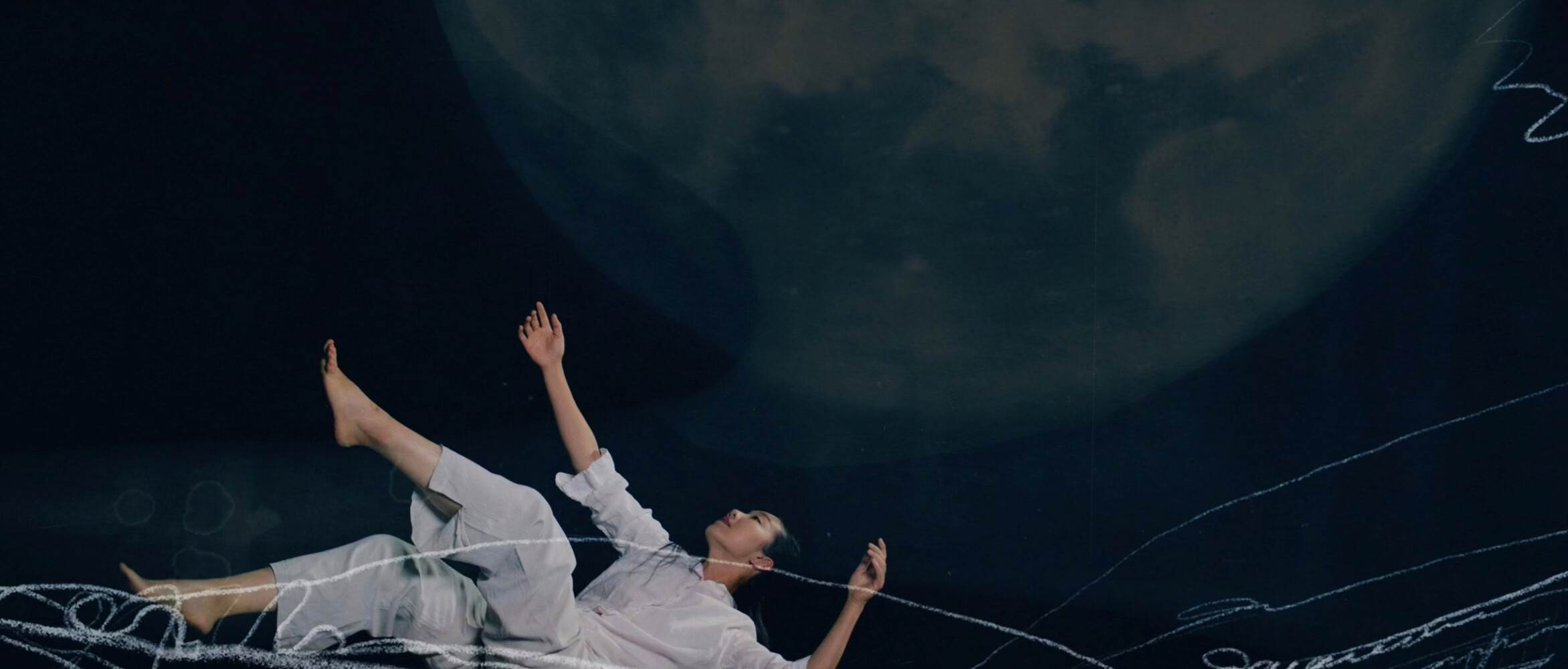
2:30 – 4:00 PM: Room — A Corporeal Dialogue Across Time (2026)
Jingqiu Guan, Choreographer/Dancer, Duke University
Han Qin, Visual Design, State University of New York at Stony Brook
Ethan Eldred, Lighting Design, Duke University
Room is a multimedia solo dance performance inspired by poems carved onto the wooden walls of the Angel Island Immigration Station, written by Asian immigrants detained and interrogated upon their arrival in the United States between 1910 and 1940. Originally staged inside a translucent cube with four projection walls activated through motion-capture choreography, the work is reimagined for the spatial architecture of Harvard’s CAMLab, where four parallel screens transform the space into a layered landscape of memory, surveillance, and inscription.
Han Qin’s visual design, combining charcoal drawing, cyanotype blueprint, and digital art derived from Guan’s original footage of Angel Island, renders the archive as both tactile and mediated, material and spectral. Within this constructed “room,” the dancer, juxtaposing the labor of birthing with the violence of immigration control, positions her body as both witness and translator, engaging in a cross-temporal dialogue with voices that persist through absence and erasure. Room invites us to ponder how we might listen to and touch our histories with openness and humility, and how freedom is imagined, constrained, and valued.
Performance to be immediately followed by a conversation with Jingqiu Guan and Han Qin, moderated by Eileen Cheng-yin Chow
4:00 PM: Reception