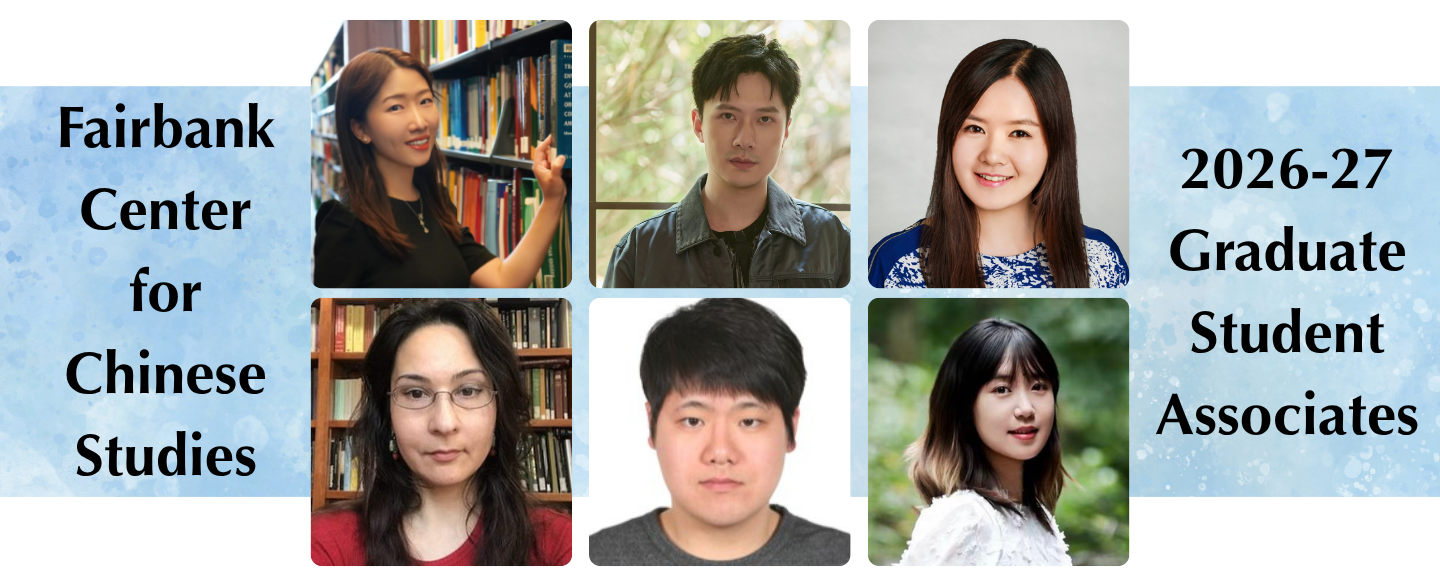
The Fairbank Center is pleased to announce this year’s GSA cohort of affiliated doctoral students
For the 2026-27 academic year, six doctoral students will join the Fairbank Center’s Graduate Student Associates (GSA) program: Katniss Li, Zhuoyu Lin, Xiao Ma, Sasha Makarova, Seongun Park, and Sophia Xiao.
The Fairbank Center’s Graduate Student Associate (GSA) program supports advanced doctoral students who are writing a dissertation in Chinese studies and preparing for the academic job market. Selected Graduate Student Associates meet biweekly to engage in professional development workshops, present their dissertation research, and exchange constructive feedback within an interdisciplinary group of scholars. Joining us from various schools and doctoral programs, this year’s GSA cohort works on topics ranging from Chinese literary communities and religious discourse to export control laws and financial regulations. Please find their profiles below and join us in wishing them a warm welcome.
Fairbank Center Graduate Student Associates 2026–27:
Xuejiao (Katniss) Li (李雪皎) is a S.J.D. candidate at Harvard Law School. Her research examines law and economic statecraft, with a focus on the interactions among governments, firms, and lawyers in the legislation, implementation, and enforcement of regulatory regimes. Her dissertation analyzes export control laws in China, the United States, and Japan through a combination of fieldwork, interviews, and quantitative analysis. Her broader research includes collaborative empirical projects with political scientists through the Research on Economic Security and Peace project, based at Oxford and Harvard Universities. Li’s professional experience includes practicing as an export controls and sanctions lawyer in Beijing, where she advised multinational firms amid U.S.–China trade tensions. She also contributed to a United Nations Conference on Trade and Development (UNCTAD) policy report on international trade treaty-making in Geneva. As a visiting scholar at Sophia University in Tokyo, she researched trade and economic security policy.
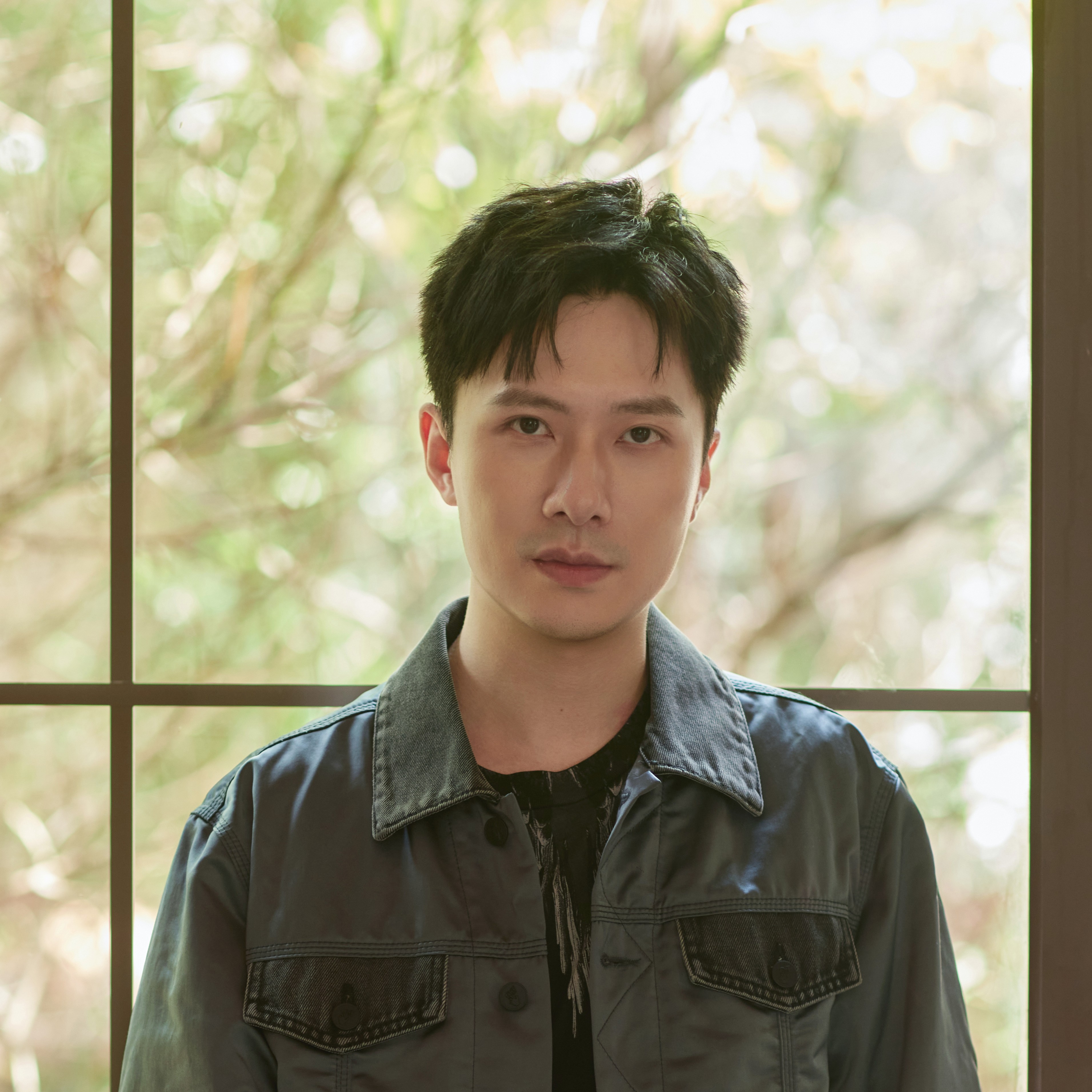
Zhuoyu Lin (林卓宇) is a Ph.D. candidate in the Department of Comparative Literature at Harvard University. His research focuses on the formation of modern Chinese readerly subjectivity in the context of the nineteenth-century hermeneutic turn. Lin’s dissertation examines shifting conceptions of what it means to read, the material and social contexts in which the reading took place, and the phenomenological experience of reading itself. Through case studies of literary works from the late Qing through the late twentieth century, his project traces how modern practices and understandings of reading developed within Chinese literary communities. While focusing on modern Chinese literature, Lin’s interdisciplinary research bridges literary theory, intellectual history, and cultural studies.

Xiao Ma (馬筱) is an S.J.D. candidate at Harvard Law School. Her research focuses on the intersection of bankruptcy, corporate law, and China’s political economy. Her dissertation examines how state authority and market discipline interact in allocating losses across the Chinese economy. Before joining Harvard Law School, Ma worked as a restructuring and litigation lawyer at Kirkland & Ellis in Hong Kong and Fangda Partners in Shanghai.
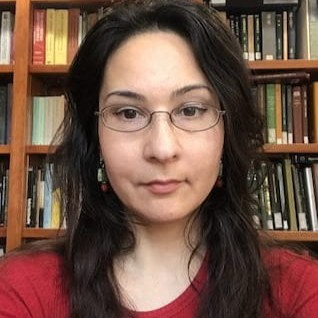
Sasha Makarova (馬靜雍) is a Ph.D. candidate in the Committee on the Study of Religion program at Harvard University. Her research focuses on medieval Daoism, with particular interest in conceptions of the body, selfhood, sexuality, and gender in religious discourse, visionary experience and visualization practice, and non-discursive modes of thought in the religious imagination. Her dissertation explores the construction of gender and the role of women in Shangqing Daoism (4th – 10th century) and centers on the notion of motherhood as a significant lens through which to approach the representations of women during the medieval period. Her theoretical perspective bridges the disciplines of East Asian history and literature, religious studies, history of medicine, and gender and sexuality studies. Before beginning her current doctoral program, she earned a Master of Theological Studies (MTS) degree from Harvard Divinity School in 2020. She holds a B.A. from the University of California, Berkeley, and a Ph.D. in Linguistics from Harvard University, awarded in 2010.

Seongun Park (朴盛運) is a Ph.D. candidate in the Department of East Asian Languages and Civilizations at Harvard University. His research explores the relationships between environmental crises, scientific knowledge, and political power. His dissertation examines disaster discourse in early modern China, tracing how new knowledge about earthquakes emerged from interactions between global cultural exchange and indigenous intellectual and political contexts, and how this knowledge became entangled with broader questions of power and authority.

Sufeng (Sophia) Xiao (肖粟豐) is a Doctor of Design candidate at the Harvard Graduate School of Design. Her dissertation develops the concept of “curated rurbanity” through ethnographically informed research in Zhejiang. Her project examines how digital platforms, rural institutions, and state agencies jointly produce spatial forms that challenge conventional distinctions between the urban and the rural, with particular attention to governance, temporality, and socio-ecological relations. In other work, Xiao has collaborated with nonprofit and civic organizations in China, Thailand, and the U.S. on community-centered design research, co-design initiatives, writing, and public exhibitions.