
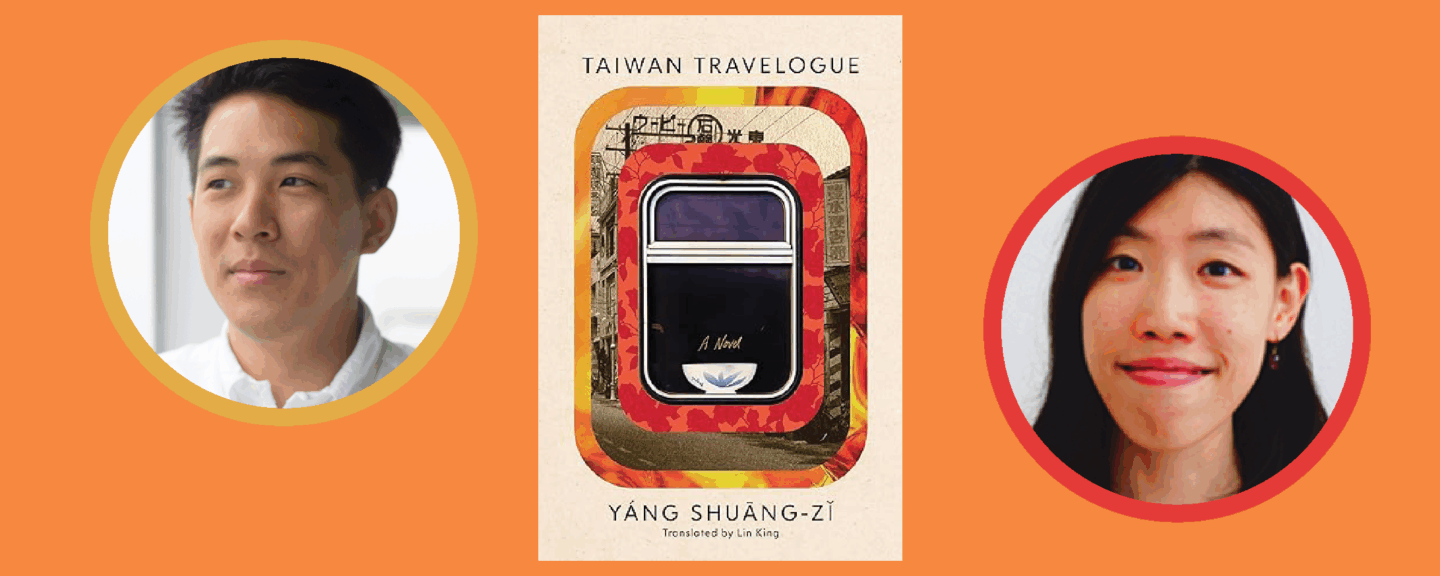

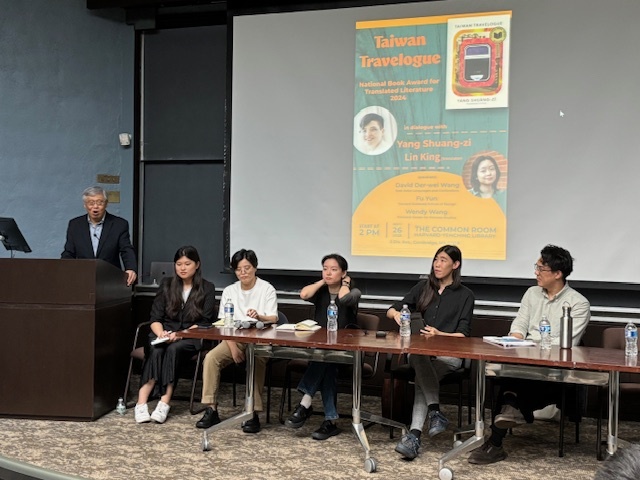
Following a recent talk co-presented by the Fairbank Center for Chinese Studies and the Chiang Ching-kuo Foundation, we asked two of its featured speakers—Yun Fu, Professor at the Harvard Graduate School of Design, and Dr. Wendy Wang, Hou Family Postdoctoral Fellow in Taiwan Studies at the Fairbank Center—to reflect further on Yang Shuang-zi’s acclaimed Taiwan Travelogue: A Novel (whose translation, by Lin King, won the 2024 National Book Award for Translated Literature). The two scholars unpack how the novel captures the rhythms of Taiwan’s everyday life, the tastes of its cuisine, and the layers of colonial and cultural history that shape its present. Through their perspectives, we glimpse why this island exerts such a magnetic pull on those who encounter it—how its “stickiness” comes from something deeper than nostalgia, rooted in a sense of adaptation, resilience, and quiet joy.
For you, what was the most important takeaway from the book Taiwan Travelogue? Why did it move you?
Yun Fu: The way life in Taiwan slowly transforms the protagonist over time, and in subtle ways, was one of the most insightful takeaways of the book for me. I came to Taiwan Travelogue as part of my own work thinking about the debate over whether the place and the idea of Taiwan are shareable, or whether any local experience is truly shareable in a global world. While in some contexts, such as Japan and Scandinavia, the articulation of a “good life” becomes mainly about exporting products through ideas, like Scandinavian and Japanese Design, for Taiwan and other smaller places caught up in great geopolitical forces, the shareability of the idea of the place itself has greater significance. I’ve always felt that the distinctive quality of everyday life in Taiwan is one of its great assets, and Taiwan Travelogue presents a particularly convincing view that it is indeed quite shareable.
Wendy Wang: As a literary scholar, I often feel compelled to “lure” more people into reading literature, especially as reading serious literature seems to have increasingly become a niche pursuit. But this wasn’t the case with Taiwan Travelogue. At every gathering where this book came up in conversation, readers from all backgrounds lit up with excitement before I could even start promoting it. Many weren’t regular book readers at all, including my mother, who hadn’t touched a novel in twenty years. This reaction shows that regardless of our dominant forms of entertainment and information, people still hunger for compelling stories and yearn to venture into unfamiliar worlds.
“I was reminded of the familiar scene at dinner banquets in Asia where adults debate and contemplate the menu like a work of literature…A pork dish, for instance, might be used to start a conversation about U.S.-Taiwan trade relations.”
Taiwan Travelogue delivers exactly that kind of story, drawing readers into an intriguing mystery where you can’t help but piece together the author’s strategically planted clues and finally approach a thoughtful revelation. Reading this novel feels like savoring a twelve-course banquet. Whether you are a seasoned reader or a newcomer, you’ll find genuine pleasure in these pages, much like how both seasoned gourmets and first-time diners can equally enjoy an exquisite Taiwanese feast.
During the panel discussion, you mentioned that you were hungry while reading! How does food play a role in this book?
Fu: It’s always interesting for me as an architect to try and get a sense of an environment when reading a book. Reading Taiwan Travelogue, with its running tally of food and drinks, I was reminded of the familiar scene at dinner banquets in Asia where adults debate and contemplate the menu like a work of literature. They consider whether it reflects the ‘vibe’—a calculus of what’s in season, what the attendees like and dislike, adjusted for their seniority, and also certain details meant to plant talking points throughout the dinner. A pork dish, for instance, might be used to start a conversation about U.S.-Taiwan trade relations.
I read the book over the summer, and it also reminded me of the expanded repertoire of summer flavors that has evolved to fill the many niches of Taiwan’s tropic-to-subtropic climate—from bitter to sour to almost medicinal. It’s a range that really stands out when you compare it to the shorter summers and narrower repertoire of flavors here in New England.
Wang: This novel tells the story of Taiwan’s culinary culture through a Japanese traveler’s eyes, making even the most common dishes appear unfamiliar and complex. It shows readers how ordinary food carries Taiwan’s complicated history, social strata, and multiethnic landscape. Take braised minced pork, for example. The book describes how different Chinese immigrant groups and social classes developed their own ways of preparing this staple dish. During the Japanese colonial era, a new snack was invented when braised minced pork found its way into sponge cakes—one of my personal favorites that this book introduces.
Taiwan Travelogue echoes Taiwan’s collective effort in recent years to redefine its culinary identity beyond the image of night market street food or manufactured products like pineapple cakes and bubble tea. Toward the end, the book presents a remarkable banquet of twelve distinctive Taiwanese dishes. Through careful archival research and vivid details, the author builds a convincing case that, alongside Western, Japanese, and Chinese culinary traditions, Taiwan has developed its own unique and refined cuisine.
You also talked about competing ideas of a good life: the American Dream, the Taiwan Dream, the China Dream. Why did you fall in love with life in Taipei?
Fu: I think it’s now a cliché to tell friends visiting Taipei that the city doesn’t really have must-visit monuments, apart from the National Palace Museum, if they’re into ‘culture,’ and that the alluring quality of the city only comes across in daily life over time.
There was a report released this summer that ranked Taipei as the “stickiest” city in the world, meaning residents are least likely to move away once they’ve lived there. It seems to capture a sense of the city that many people experience but which isn’t easily describable. For me, the allure of Taipei is the way the seasons and climate still pervade contemporary life. There are things to eat, do, read, and play across a nuanced gradation of seasonal changes—a particular fish* to eat in the two weeks around the winter solstice, or the way umbrella stands quietly appear on every doorway overnight during the rainy season and then disappear again. Individually, none of these things are particularly remarkable. But the way they fit together into a cohesive way of life rooted in local cycles yet made compatible with modern things like jumping on a high-speed rail for a meeting on the other side of the island and getting that seasonal fish to-go in a bento box—that’s quite rare and difficult to replicate.
*烏魚子, or dried mullet roe. It’s always struck me that, although it seems quite accessible, everyone somehow has a “fish roe guy” who can secure a secret, premium supply unavailable through normal channels. They also seem to have inherited a particular way of eating it—like a secret handshake that shows you are truly local and rooted in the land, passed down from an earlier generation, that they now share with you in confidence.
“I read the novel as a rejection of this illusion that pursuing a “better life” means yearning to become someone else. The constant reflections on the historical baggage of colonial and authoritarian experiences, together with an embrace of metropolitan life and thought, create a cultural uniqueness in Taiwan that continues to generate this “stickiness” for both Taiwanese and their international friends.”
Wang: The novel leads readers to grapple with a fundamental question: “What constitutes a good life in a colonial society?” It presents an intriguing answer through one woman’s life choices. When the wealthy Japanese writer offers her dear friend, a Taiwanese woman, the chance to live in Japan and escape an arranged marriage to pursue her own career, the Taiwanese woman declines and stays in Taiwan, marrying a man she barely knows. The novel captures how colonial relationships complicate their friendship. The Japanese writer’s good intentions ultimately reveal themselves as a form of colonial self-indulgence. She unconsciously wants to preserve the vanishing cultures of the colony and “rescue” the suffering woman there.
Perhaps the Taiwanese woman’s decision to stay in her homeland in the novel demonstrates the “stickiness” of Taiwan. Colonial experience introduced Taiwanese society to metropolitan ways of life for the first time. This prompted generations of Taiwanese people to look toward Japan, the U.S., or China for a freer or economically “better life.” However, I read the novel as a rejection of this illusion that pursuing a “better life” means yearning to become someone else. The constant reflections on the historical baggage of colonial and authoritarian experiences, together with an embrace of metropolitan life and thought, create a cultural uniqueness in Taiwan that continues to generate this “stickiness” for both Taiwanese and their international friends.
What’s so special about 7-Elevens in Taiwan?
Fu: Many people have talked about the 7-Elevens in Taiwan because they seem to capture a certain essence of life there, in the same way walking through a Costco for the first time seems to grant you a deeper understanding of the American way of life.
There is, of course, the way the history of 7-Eleven in Taiwan resonates with the country’s recent history: it started as an American brand with its rotating hotdog stand; was adopted by the Japanese, who added a catalog of impressively fresh sandwiches supported by just-in-time logistics; and then was transformed again when it landed in Taiwan, with food offerings expanding into a buffet of boiling broths and soups. The rotating hotdog stand often still remains in the corner, a little souvenir of Americana. It seems to speak to how foreign influences are adopted and made one’s own, not just in Taiwan but across the Asia-Pacific islands.
But of course, the most special thing is that you can get a remarkably fresh meal in the wee hours of the morning for a handful of change, while also paying your taxes, collecting your online shopping, and contemplating that rotating hotdog stand while you wait for the cashier to grab your package.
Why is it important to look at the Japanese colonial past in Taiwan? Does it somehow help us understand today?
Fu: There’s the obvious parallel of how to live well next to a great power. But more deeply, looking at the Japanese colonial period seems to help to contextualize the current moment amongst the many waves of influence that have hit Taiwan’s shores. It shows more clearly what has changed and what has remained constant over time.
What I think has remained constant—and what the story foregrounds for me—is a characteristic tied to Taiwan’s Austronesian roots: an openness to new things, combined with an almost irreverent instinct to adapt those things to fit local, practical needs—transforming it in unexpected ways in the process. We see this with Japanese influence, just as we see it with later and earlier American and Chinese influence. Understanding that past, I think, helps us be more optimistic about the near future, and also points to the distinctive quality of Taiwan as, in certain ways, a laboratory for living well in an uncertain world.
Wang: When describing Taiwan’s Japanese colonial past, the novel neither romanticizes this history nor victimizes those who lived through it. Instead, it presents colonial life as constant negotiation where people moved forward through conflicts and compromises, sometimes clashing, sometimes finding agreement. In the novel’s depiction of Taiwan’s dining tables from a century ago, we see an immigrant society navigating multiple colonial experiences, where people from different backgrounds discovered they could share the same table over tea and roasted seeds.
The author challenges a predominant narrative about Taiwan’s “identity struggle” and abandonment complex caused by successive colonial experiences. Rather than portraying Taiwanese as either sycophants or orphans, this novel presents them as strategic, pragmatic negotiators within colonial relationships. This negotiation continues today. Within its borders, Taiwanese society engages in ongoing civic engagement through street protests, social organizations, and advocacy work, where everyone finds a role in issues such as marriage equality or disaster recovery. Beyond its borders, Taiwan remains a pragmatic negotiator navigating relationships with various international powers. From colonial-era dining tables to today’s negotiating tables, Taiwanese people have consistently worked to forge a path that is neither deferential nor domineering.