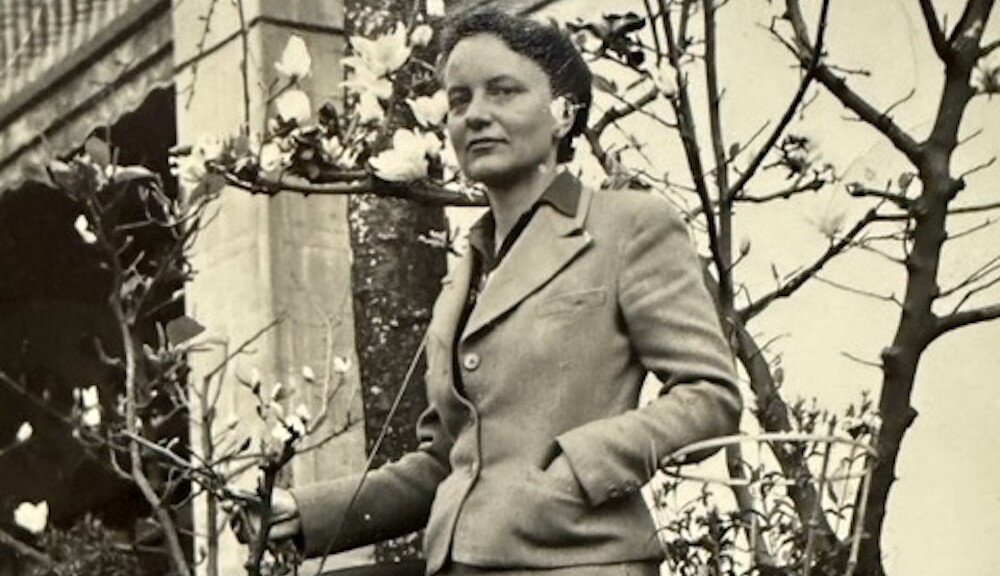
Professor John King Fairbank and Wilma Cannon Fairbank lived in Beijing during the 1930s, as John pursued his dissertation research and Wilma painted and researched ancient temples. During that time, they became best of friends with a dynamic, cosmopolitan Chinese couple, Liang Sicheng—the father of architectural history in China—and Lin Huiyin, an architect and poet. That friendship is the subject of a Fairbank Center exhibition, “Once Upon a Time in Peking, A Very Special Friendship,” on view in the CGIS South Building until December 17.
The Fairbanks returned to Chongqing in the 1940s to work in the U.S. embassy on cultural exchange, forging ties with leading Chinese intellectuals. Ruiheng Wang, an Associate Professor of History at Nanjing University and a Visiting Scholar at the Harvard-Yenching Institute this year, has conducted deep research on U.S. cultural relations programs toward China in the 1940s. In this Q&A, Professor Wang talks about the Fairbanks’ work in China during World War II and why it matters even today.
Wilma and John Fairbank came back to China in the 1940s during the war to work on U.S.–China cultural affairs. What were they each doing?
Ruiheng Wang: The Fairbanks played a central role in the U.S. government’s wartime and early postwar cultural relations initiatives with China, collectively known as the “China Program.” Wilma Fairbank was its first staff member in the Division of Cultural Relations at the State Department. She began working on this program in January 1942, shortly after Japan’s attack on Pearl Harbor, helping to design and carry out many of its projects. What started as cultural assistance to China soon evolved into a genuine two-way exchange of people and academic resources between the two countries. In May 1945, Wilma was sent to Chongqing, China’s wartime capital, as Cultural Attaché to oversee the program on the ground. After Japan’s surrender, she moved with the U.S. Embassy to Nanjing and stayed there until April 1947, when the project came to an end.
John King Fairbank was one of America’s few American “China hands” at the time of WWII. Working closely with his wife, he helped shape U.S. policy on cultural relations with China and handled much of the communication with the Nationalist government. During his stay in Chongqing from September 1942 to late 1943, he collected Japanese publications for the Office of Strategic Services while also coordinating the distribution of microfilmed English-language books and journals to Chinese universities and scholars. After the war, Fairbank returned to China in October 1945 for another nine months to direct American information and cultural programs. Drawing on his intersecting roles in intelligence, education, and public information, he became a key figure in America’s wartime cultural diplomacy.
What kinds of connections did Wilma Fairbank make in the cultural sphere? Did the U.S. government support Chinese intellectuals at that time?
Wang: During the war, Wilma’s home in Georgetown, Washington, D.C., became a warm gathering place for visiting Chinese scholars, American “China hands,” and U.S. officials—what the Chinese sociologist Fei Xiaotong (费孝通) fondly called “Madame Fairbank’s living room.” Through their extensive networks in both academia and government, the Fairbanks provided vital social capital for the success of the China Program.
The program itself offered crucial material and institutional support to Chinese intellectuals. It sent research materials and laboratory equipment that were in short supply, dispatched American specialists to offer technical assistance, distributed educational and cultural films, sponsored visiting Chinese scholars in the United States, and provided relief and support to Chinese students and trainees during their stay. Together, these efforts not only aided China’s wartime reconstruction and national development but also fostered long-lasting transnational exchanges of knowledge between Chinese and American scholarly communities.
-with-Dr.-Karl-P.-Schmidt-and-his-wife-in-the-United-States-1946-1024x750.png)
Did the U.S. government help to invite some of them to visit the U.S. for cultural exchange? What are some examples?
Wang: Yes. Between 1942 and 1947, the China Program sponsored four groups of visiting Chinese professors and artists—twenty-seven people in total.
The first group, known as the “Six Professors Mission,” brought together leading scholars from six of China’s top universities. Among them were political scientist Liu Naicheng (刘迺诚) of Wuhan University, physiologist Cai Qiao (蔡翘) of National Central University, sociologist Fei Xiaotong of Yunnan University, and philosopher Jin Yuelin (金岳霖) of the National Southwest Associated University. They participated in a symposium at the University of Chicago, the proceedings of which were later published as Voices from Unoccupied China (Chicago: University of Chicago Press, 1943), presenting Chinese perspectives on wartime society to an American audience.
The final group included four well-known Chinese artists whose impact reached far beyond academia. Novelist Lao She (老舍) saw his works translated into English and published; playwright Cao Yu (曹禺) collaborated with American dramatists to adapt his plays; cartoonist Ye Qianyu (叶浅予) held exhibitions in several U.S. cities; and dancer Dai Ailian (戴爱莲) both performed and taught traditional Chinese dance at American theaters and universities. Their achievements—widely covered by the American press—helped shape U.S. cultural perceptions of China during the 1940s.
These exchanges not only deepened intellectual understanding between the two countries but also served broader wartime goals.
-copy.png)
Why was the U.S. government doing this?
Wang: Before World War II, the U.S. government treated culture as part of the private sphere, guided by liberal ideas of volunteerism and reciprocity. Missionary groups and private foundations led most of the educational and cultural exchanges between China and the United States. But these exchanges were largely one-way. Many Chinese students went to America to study modern science and Western knowledge, while Americans knew little about China and showed limited interest in learning more.
World War II changed that dynamic dramatically. The nature of total war not only transformed official attitudes toward culture but also revealed how little Americans actually knew about the wider world. As historian Frank A. Ninkovich observed, “World War II was perceived, at least in part, as being a cultural struggle.” In 1938, to counter Axis cultural influence in Latin America, the State Department established the Division of Cultural Relations, bringing culture into the realm of diplomacy for the first time. After the outbreak of the Pacific War, this effort expanded to China—America’s key Asian ally—often described as a kind of “Cultural Lend-Lease.” The aim was to use cultural assistance to boost Chinese morale, strengthen wartime cooperation, and cultivate pro-American intellectual circles when economic and military aid was limited.
By the end of the war and in the early postwar years, the China Program’s practical aim of helping the Nationalist government resist Japan gave way to a stronger ideological agenda—promoting democratic values in China. This brought the program into contradiction with the Nationalists’ authoritarian rule and made many Americans realize the true nature of their ally. Cultural exchange, after all, can encourage understanding and empathy, but it cannot easily export political ideals.
When did those exchanges end, and why?
Wang: The China Program was funded through the President’s Emergency Fund rather than by Congressional appropriation, making it a temporary wartime measure rather than a permanent institution. When that emergency funding ended in June of 1946, the program was gradually phased out and officially closed the following year.
Even so, the experience helped lay the foundation for America’s postwar system of cultural diplomacy. On August 1, 1946, President Truman signed the Fulbright Act, creating a global framework for educational exchange. China became the first country to sign an executive agreement under the Fulbright Program in November 1947. Although the Chinese Civil War soon disrupted the program’s operation, a number of scholars and students still benefited from the exchanges during 1948–49. After the two countries severed diplomatic ties in 1949, the program was suspended on the Chinese mainland but continued in Taiwan and was eventually reinstated on the mainland after the normalization of relations in 1979.
When U.S.–China diplomatic contact resumed in 1971, were those connections with intellectuals important in reviving U.S.–China exchanges?
Wang: Yes. The rapprochement of the 1970s partly revived the academic networks that had first taken shape in the 1940s. The Committee on Scholarly Communication with Mainland China—later known as the CSCPRC—became a key channel for rebuilding those ties, and John Fairbank was involved in its work.
In 1972—nearly thirty years after their wartime experience in China—the Fairbanks joined the first delegation of American scholars to visit the People’s Republic of China, where they met Premier Zhou Enlai, Vice Minister Qiao Guanhua, and old friends such as Fei Xiaotong and Jin Yuelin in Beijing. After the normalization of U.S.–China relations in 1979, Fei Xiaotong revisited the United States as part of a delegation from the Chinese Academy of Social Sciences and reconnected with many of his wartime colleagues.
Although most of the wartime network’s participants had by then passed away or retired, a few continued to serve as informal intermediaries in the process of normalizing relations between the two countries.
Are those connections even important today?
Wang: Absolutely. The close intellectual exchanges of the 1940s—supported by both governments as well as by academic organizations and individual scholars—created lasting transpacific networks linking people, disciplines, and institutions. The outcome went far beyond what the U.S. government had expected when launching the China Program; it grew largely from the initiative and collaboration of scholars on both sides.
When Fairbank returned to Harvard in 1946, he drew on his wartime experience to design new courses on China and to write his landmark book The United States and China, which deeply shaped American understandings of China during the Cold War. The Fairbank Center at Harvard continues this legacy as a leading hub for U.S.–China academic exchange.
Yet such exchanges are now under growing strain amid renewed geopolitical rivalry between the two countries. The Trump administration’s termination of the Fulbright Program in mainland China and Hong Kong in 2020, followed by visa restrictions on Chinese scholars and students, has further eroded mutual trust. Cultural relations, after all, are both a barometer and a test of diplomacy. The freer the movement of knowledge and ideas, the deeper the understanding between peoples and nations—and both governments share the responsibility to safeguard this fragile but essential bridge.