
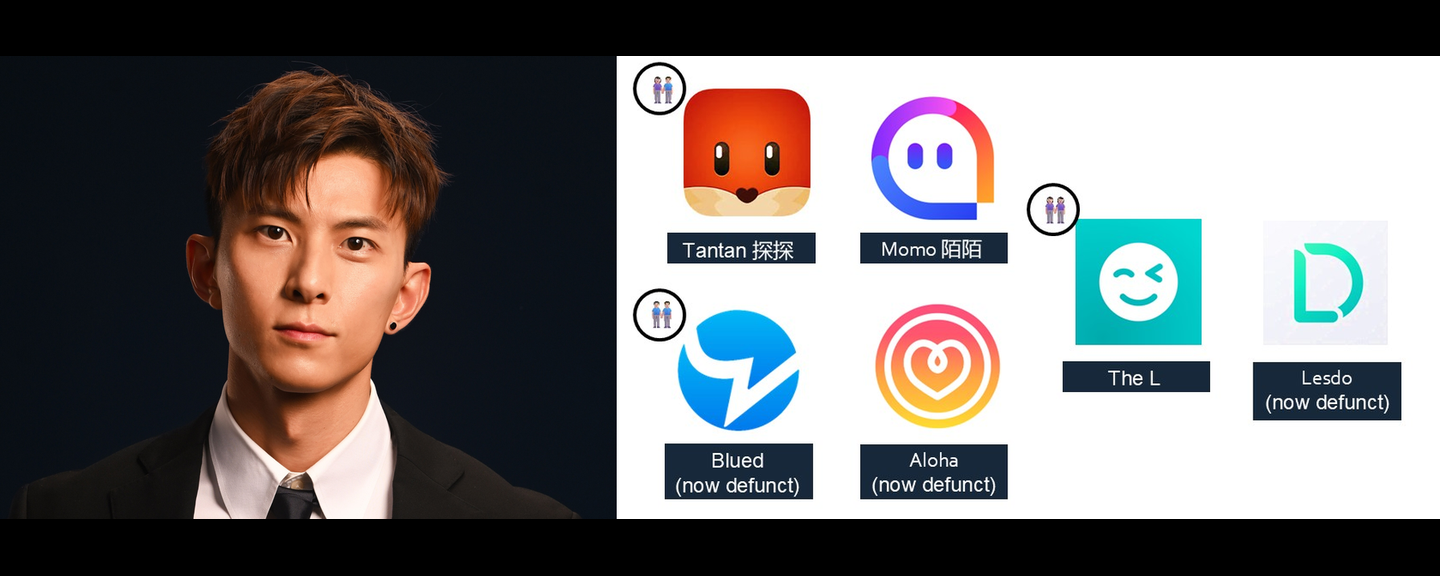

Last fall, the Urban China Lecture Series welcomed sociologist Lik Sam Chan, a Lecturer at the University of Sydney, to discuss his book The Politics of Dating Apps: Gender, Sexuality, and Emergent Publics in Urban China (The MIT Press, 2021). Rather than treating dating apps as purely digital phenomena, Chan invites us to see them as part of the everyday infrastructure of Chinese cities—spaces where intimacy, mobility, and inequality intersect. Drawing on long-term digital ethnography that’s attentive to how online interactions spill into streets, neighborhoods, and social worlds, Chan’s research shows how ordinary practices like swiping and chatting are deeply entangled with the social, economic, and spatial transformations reshaping urban China today. The interview below delves deeper into Chan’s analysis of social difference and inequality on dating apps, as well as his reflections on the research ethics of conducting “digital ethnography.”
In your research, you describe dating apps in urban China as creating different kinds of “networked publics,” shaped by gender and sexuality. Why was it important for you to look across these differences?
Looking across gender and sexuality differences was crucial to me because it revealed how the same behavior—say, seeking sex on dating apps—carries completely different meanings depending on who you are. This goes beyond simply cataloging different user motivations, a common approach in much dating app research.
For my straight female informants, sex-seeking represented a laboratory for sexual experimentation and self-discovery. I recall how they told me about exploring the relationship between sex and romantic relationships, or enjoying the interplay between familiarity and strangeness. Dating apps became spaces for straight women to explore aspects of sexuality that formal education doesn’t cover.
In stark contrast, my straight male informants framed sex-seeking as a physiological behavior. A young college man described his app use as fulfilling a basic biological need, linking it to “what everybody has, especially men.” My queer female informants showed yet another pattern, with an underlying de-emphasis on hookup culture in their community. One informant told me that, as lesbians, they chat a lot. What mattered wasn’t the act of hooking up but the communication leading to it.
This intersectional approach revealed that identical platform behaviors carry different meanings, which relate to users’ positions within patriarchal and heteronormative structures.
Dating apps simultaneously open spaces for resistance while reinforcing existing hierarchies.
Many people feel that dating apps don’t treat all users equally. In China, do these platforms tend to reinforce existing gender and sexual hierarchies, or do they open up space for new forms of connection and resistance? What kinds of social order do dating apps seem to produce?
In my book, I describe dating apps in China as creating a relational dynamic between resistance and dominance, where both coexist within the same power structure. I would say that dating apps simultaneously open spaces for resistance while reinforcing existing hierarchies.
On the resistance side, I witnessed remarkable moments of agency. Straight women exercised sexual autonomy and reverse-objectified the men they encountered. My lesbian informants learned coming-out techniques from live streams on dating platforms, accessing resources unavailable in mainstream media. These apps became crucial infrastructure allowing queer women to build community (or what they call the quanzi), providing emotional support, information, and advocacy opportunities.
However, the same platforms also reproduce hierarchies in troubling ways. When women used dating apps, they faced additional scrutiny that men did not face. Using dating apps was seen as sinful for women. When women used dating apps for business purposes as salespeople, sex workers, or bar promoters, men dismissed these activities; yet, they celebrated their own entrepreneurial networking on dating apps. This reflects a much deeper labor market inequality where men claim “good business” while stigmatizing women’s economic survival strategies.
Lesbian dating apps, while creating vital community spaces, perpetuate heteronormativity through rigid gender classifications. On many apps for queer women, users must choose labels like T (masculine), P (feminine), or H (versatile), assuming fixed, singular gender identities. This reproduces the very binary thinking that queer theory challenges.
Therefore, the social order these apps produce isn’t liberation or domination alone, but complex spaces where agency exists alongside mechanisms that reinforce patriarchy and heteronormativity.
Urban space doesn’t disappear through digitization. Instead, it gets reconfigured, with dating apps serving as an infrastructure for navigating China’s complex metropolitan landscapes.
Dating apps are often framed as platforms that free people from physical constraints, yet they rely heavily on location features like “people nearby.” In your research, how does urban space still matter?
Urban space remains absolutely central to dating app experiences, far from being transcended by digital connectivity. In my research, location also operates as both liberation and constraint, deeply shaped by China’s urban realities.
For rural-to-urban migrants, dating apps become crucial tools for navigating urban space. My informant Xiaoshan’s case reveals how apps substitute for absent urban kinship networks. Working as a hotel masseuse with her family far away in Guangxi, she found that Momo became her “third place” where she found hiking buddies and companionship. She couldn’t use WeChat because her family and friends would worry, so dating apps provided location-specific sociability invisible to hometown networks.
The proximity features that men used strategically demonstrate urban space’s continued relevance. One straight male informant calculated that when he and potential matches were physically nearby, his success rate would be higher. Some set strict distance limits, refusing contact with people more than four kilometers away.
For gay men, urban context profoundly shaped emotional experiences. In cities without major established gay neighborhoods like Guangzhou, Blued’s grid of nearby profiles became a symbolic village—proof of community existence. One informant described how apps allowed Guangzhou tongzhi to survive by creating ad hoc queer spaces that overlay visibility onto heteronormative urban structures. This community has, unfortunately, disappeared after the recent crackdown on gay dating apps in the country.
So, urban space doesn’t disappear through digitization. Instead, it gets reconfigured, with dating apps serving as an infrastructure for navigating China’s complex metropolitan landscapes.
You use digital ethnography to study intimate life online, which is still a relatively new approach. What were some of the biggest challenges you faced, and what advice would you give to emerging young scholars who want to study digital platforms and everyday life?
When I began this study ten years ago, academic understanding of dating app research ethics was underdeveloped. I created research accounts on heterosexual and gay dating apps (lesbian apps prohibited male accounts), passively waiting for interested users while sending brief research invitations to others.
After years of discussions with users and research colleagues, I now see this approach as problematic. While dating apps appear as public spaces, like parks, users operate under an assumption that others are there for social, romantic, or sexual connections. As researchers, we violate this shared understanding, becoming like the insurance or beauty product sellers that users complain about.
This methodological reflection has compelled me to reconsider research practices on platforms like dating apps. Users expect authentic interactions, not research recruitment. Some platforms now explicitly prohibit research activities in their terms of service. For the past several years, my students and I have avoided directly recruiting through dating app accounts.
My advice to young scholars is threefold: First, always prioritize user expectations and platform norms over research convenience. Find alternative recruitment methods through community organizations, general social media posts, or snowball sampling rather than masquerading as regular users. Second, remember that digital spaces aren’t simply “public” because they’re accessible. They carry specific social contracts and intimacy expectations that researchers must respect. Third, engage deeply with evolving research ethics discussions in internet studies. What seemed acceptable a decade ago may be recognized as problematic today. Our methods must evolve with our understanding of digital privacy, consent, and user agency.
The intimate nature of dating apps demands especially careful consideration of how our research presence affects the very communities we aim to understand.