

Yi Zhang is a Ph.D. candidate in the Department of East Asian Languages and Civilizations and a 2025-2026 Graduate Student Associate of the Fairbank Center for Chinese Studies. Below, she draws on her research to illustrate how newly-wealthy merchants in 16th Century China aspired to raise their social standing through literary pursuits.
In sixteenth-century China, merchants could become extraordinarily wealthy, but money did not automatically bring social prestige. In the premodern social hierarchy, scholar-officials stood at the top, while merchants, however rich, remained culturally marginal. So just like in contemporary society, there was social striving—the effort of the “nouveau riche” to be accepted among the literati elite. An unusually rich paper archive assembled by Fang Yongbin (方用彬, 1542–1608), a pawnbroker from Huizhou, a wealthy area of Anhui province, reveals one merchant’s lifelong effort to become a man of letters. These materials open a rare window onto the uneasy ways in which mid- to late-Ming merchants pursued cultural status.
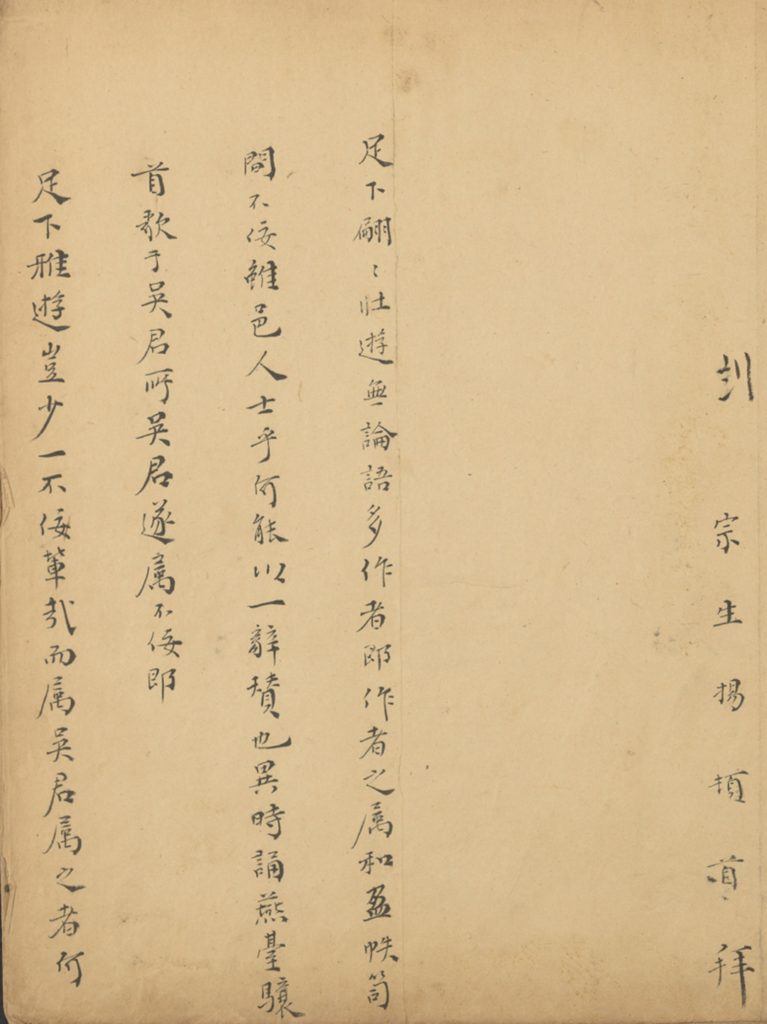
The archive records Fang’s literary exchanges with officials, literati friends, and kinsmen. In one letter, the official Zhang Yingtai (張應泰) praises a poem that Fang had written on a fan presented to him, saying that “each character is a beautiful jade.” Such praise suggests that Fang was not only literate but capable of composing poetry that won recognition from highly educated readers. In another letter, the official Fang Yang (方揚, 1540–1583) celebrates the many poems Fang Yongbin had solicited from his friends, describing them as possessing a “resonant grandeur” that surpassed even “white snow in spring,” a classical phrase for songs of the highest refinement. Fang Yang also called pawnbroker Fang’s travels “elegant journeys,” suggesting that his movements as a merchant could also be imagined as occasions for literary sociability. These traces show that Fang was actively participating in literati networks, where writings, calligraphy, paintings, seal carvings, books, and antiques circulated as objects of social and cultural exchange.
In Fang’s time, success in the civil service examinations was the most recognized path to elite status, as it offered a route into officialdom. For merchants seeking social recognition, wealth alone was insufficient: they often had to pursue this highly competitive route of gaining entrance into the civil service, either for themselves or through their sons, in order to convert economic success into acknowledged social standing.
A letter reveals that Fang was still struggling to prepare for the examinations until the age of 47—but there is no evidence that he ever managed to pass. Chen Zhichao (陳智超), the pioneering modern-day scholar of this archive, described Fang as a “Confucian merchant,” a man who practiced commerce while pursuing literature and learning. My dissertation advisor, Thomas P. Kelly, pushes this formulation further, showing how Fang’s career reveals “new alignments between aesthetic pursuits, mercantile experience, and craft knowledge.” Fang’s case, therefore, suggests another way of becoming at least “literati-like”: not through examination success alone, but through the practices of writing, collecting, making, exchanging, and moving within literati circles.
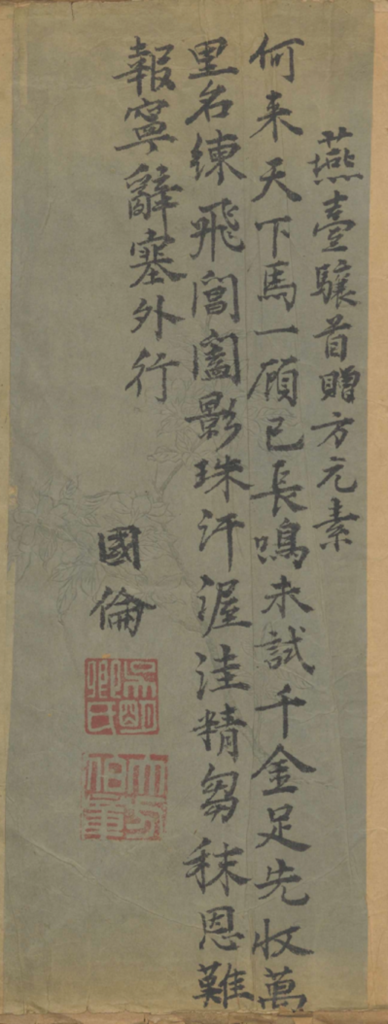
A collection of poems, written to commemorate Fang’s journey north to the National Academy in Beijing, illustrate how Fang’s ambition emerges through poetic imagination. In these poems, Fang presents himself as a “thousand-li horse”: a legendary steed waiting to be recognized—and, in the old story, purchased—by a discerning ruler. This poetic imagination was especially resonant for men from merchant families like Fang, for whom the pursuit of recognized status could involve not only examination success, but also monetary donation, an increasingly common but still contested route in the mid- to late-Ming. Here, the recognition of talent did not depend solely on success in the conventional examination system but could also be figured through market metaphors of the judicious buyer and the worthy commodity.
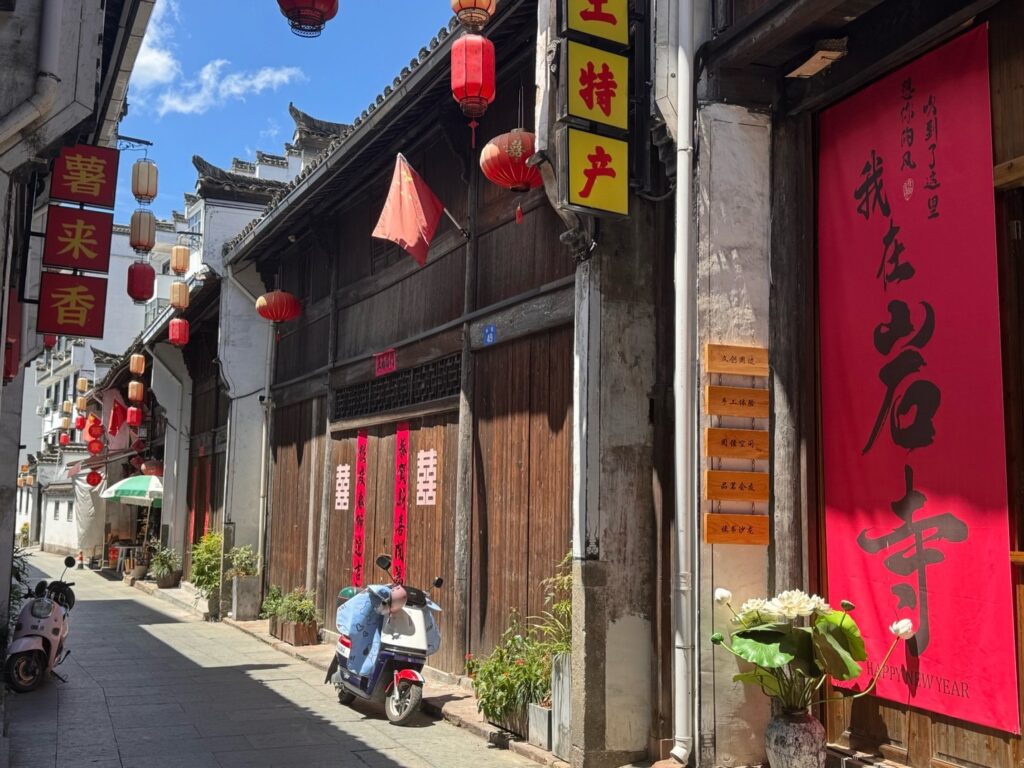
Fang came from Yansi, a commercial center in Huizhou, a mountainous region in southern Anhui province famous for producing some of the most influential merchant families of late imperial China. Huizhou merchants made their fortunes through long-distance trade, especially in salt. Over time, they became known not only for their wealth, but also for their cultural ambitions: investing in education, publishing, architecture, gardens, and art collecting. Their influence lasted well into the nineteenth century. Fang, however, lived at an earlier moment, when these merchant networks were still taking shape and the cultural pursuits of merchant families had not yet become the norm.
Pawnbroking was a trade closely associated with wealthy Huizhou merchants. It required substantial starting capital, which made it especially suitable for Huizhou merchant families already enriched through the salt trade. Yet Fang’s pursuit of literati recognition produced a striking paradox: he was a pawnbroker whose livelihood depended on financial resourcefulness, but his own elegant life of travel, sociability, and literary exchange could leave him short of money.
Wang Daokun (汪道昆, 1525–1593), a senior figure from Fang’s native region, describes him as “coming from a once-prosperous family but becoming poor through travel.” Fang Hongjing (方弘靜, 1516–1611), a senior kinsman, captures both Fang’s generous, almost chivalric spirit and his literary talent in a couplet: “even when short of gold, he still borrowed to entertain guests; proud of his brilliant brush, he yet stepped once more onto the literary stage.” Fang’s predicament was not unique. It points to a broader tension faced by many Huizhou merchant descendants, for whom commercial wealth could support literary aspiration but could not always sustain the costly practices of literati life.
From the perspective of financial history, Fang’s paper archive also offers an unusually valuable example of how sixteenth-century pawnbroking depended on handwritten forms of trust in the absence of a uniform credit system comparable to modern banking. In one short letter, Fang Da’ao (方大滶), a cousin of Fang Yongbin, requests silver from Fang. Especially notable is a slip of darker paper pasted at the center of the document, likely added by Fang Yongbin, identifying it as Fang Da’ao’s note requesting a pawn loan in silver. There is also a red annotation—perhaps also in Fang’s hand—recording the date and amount: “two taels loaned on the twenty-ninth day of the first month of the forty-fifth year [of the Jiajing reign].” These material details show how a personal letter was transformed into a pawn note. In a world without standardized credit institutions, financial trust depended on both social relationships and the visible traces left on paper.
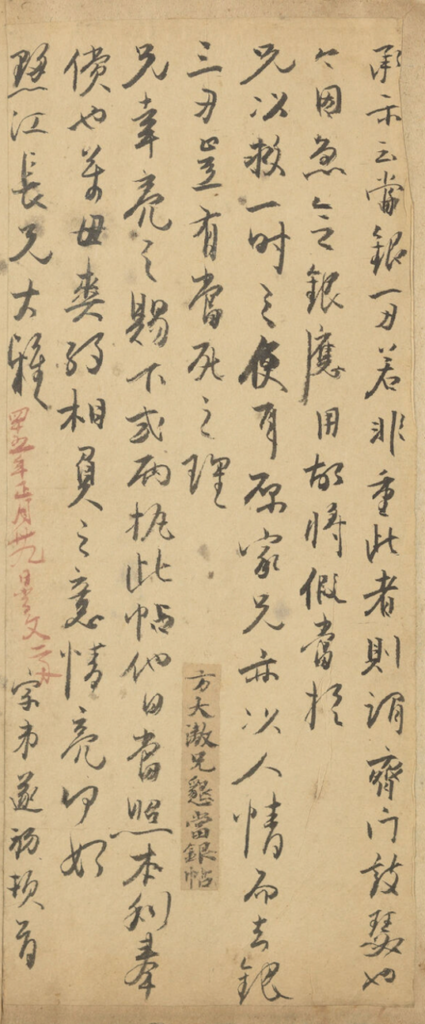
Fang’s life reveals a society in which money and culture were deeply intertwined. A letter could become a credit instrument; a poem could turn a merchant into a literary talent awaiting recognition. Even the traces of exchange and transaction could be preserved—as Fang himself suggested—as treasured brushwork. Fang Yongbin never became a famous official or canonical poet. Yet through the ephemera he kept, we can see how one merchant negotiated the difficult passage from wealth to status. His archive shows how the life of an otherwise obscure pawnbroker could be made, credited, and remembered.