
Every summer, the Fairbank Center for Chinese Studies supports undergraduate students as they set off to pursue research interests across the world. The Fairbank Center’s Summer Research Grants help undergraduate students pursue projects that often become central to their senior theses. We’re proud to champion this innovative work and help push Chinese studies into new fields and conversations.
When students return from their travel, they share reports reflecting on what they learned, the challenges they encountered, and how their own research was further shaped by the experience. These reports are always exciting reads for us—not only because they tell us more about our students’ research topics, but because they reveal much about the researchers themselves.
This year, we’re excited to spotlight a few of the stories from our Summer Research Grant recipient pool—which offer a window into the individual journeys of these young scholars.
Across disciplines and continents, these student researchers carried the Fairbank Center’s mission into archives, living rooms, construction sites, fashion hubs, and migrant communities. Their work underscores how undergraduate curiosity—when supported with resources, mentorship, and global access—can illuminate questions of identity, history, and contemporary China’s place in the world. We can’t wait to see where their academic careers take them next.

Efrem Bonnetti (‘26) Traces Lives Across Empires
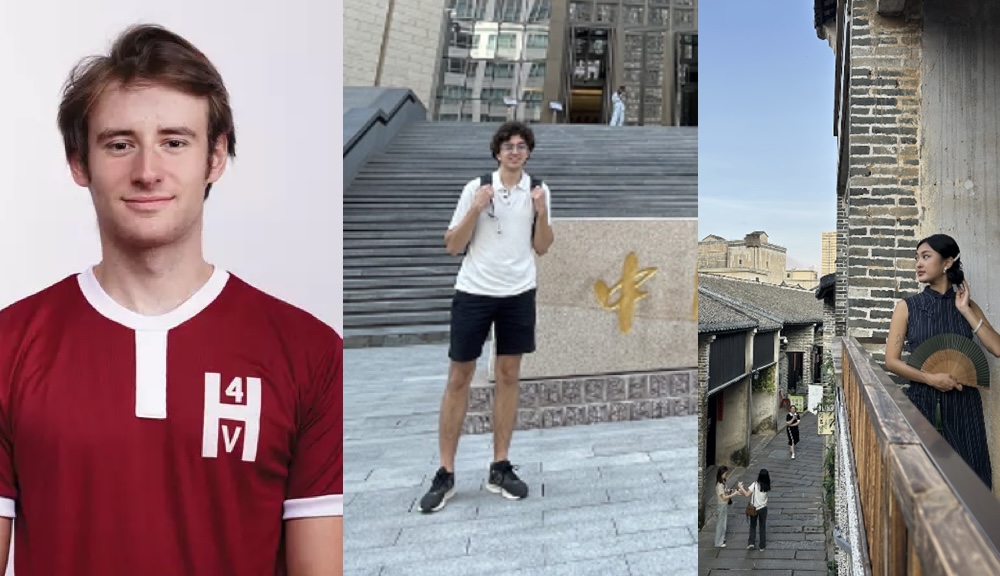
For graduating senior Efrem Bonnetti, the summer’s work unfolded inside reading rooms and archives dotted across Beijing, Tianjin, Nanjing, and Shanghai. His project explores the lived experiences of Chinese residents in treaty-port concessions during the late Qing and early Republican era. Efrem, a joint concentrator in Government and History, describes his summer research experience as transformative—not just for the materials he was able to access, but for the people that he met along the way.
“The trip was a success thanks, in no small part, to the interactions with professors and students. They introduced me to readings, databases, and scholars, explained current historiographic debates related to my work and alerted me to their relevance, and offered to continue assisting me in the future.”

Those conversations deepened his sense of purpose and clarified why this moment in history matters:
“This experience allowed me to gather materials for my work, but even more to understand why I care about the questions I am exploring in the first place. I believe that learning about late-imperial and republican China’s encounter with and exploitation by European and American nation-states can give us a better understanding of the country’s ongoing domestic transformations and public sentiment.”
By the end of the trip, Efrem felt more certain than ever about continuing this research beyond Harvard.
“My conversations with Chinese scholars and my readings in the archives have strengthened my conviction to continue engaging with these topics through graduate studies and, hopefully, a longer stay in China in the future. I am making a contribution to an ongoing debate on colonialism, the meaning of modernity, trade, and the world order—issues that are of concern to anyone hoping to make sense of current international relations.”
Sam Davidson (‘26) Researches Chinese Migration in West Africa
While some students traveled east, Sam Davidson traveled south and west—to Praia, the capital of Cape Verde, a small island nation shaped by centuries of migration and trade. Sam, a joint concentrator in Social Studies and East Asian Studies, set out to understand how large-scale Chinese infrastructure investment, often related to the Belt and Road Initiative, intersects with the everyday experiences of Chinese migrant shop owners. His month in Praia blended ethnographic walks, interviews, and street-level observation.

organization.
“I received funding this summer to research the Belt and Road Initiative in Cape Verde … There is a sizable Chinese immigrant community living in the country, and Chinese-run shops can be found in nearly every town throughout the archipelago. I was interested in the connections between these two levels of engagement. How were the infrastructure investments tied to the migration? How did Cape Verdeans perceive both?”
He embedded himself in neighborhoods across the city:
“To answer these questions, I spent four weeks in Praia, the capital city. I visited the major infrastructure projects in the city, speaking with Cape Verdeans and Chinese involved in their construction. I walked every street of every major neighborhood, building a map of all the retail stores in the city. I struck up conversations and interviewed dozens of these storeowners, hearing their stories of leaving rural villages in China for the first time to come to a tiny island nation and open businesses.”
The deeper he dug, the more he uncovered a disconnect between outside narratives and lived realities:
“What I came to realize is that there was a gap between the perceptions of the Chinese presence in Cape Verde and its reality … I was honored that my interlocuters trusted me with their stories and welcomed me into their communities, if only for a brief month. I am also deeply grateful to the Fairbank Center for giving me this opportunity.”

Stephanie Hu (‘26) Encounters Fashion and Cultural Revival
Stephanie Hu, who’s concentrating in Sociology, spent her summer in the fast-moving world of Shenzhen fashion studios, markets, and homes. Her senior thesis explores the rise of neo-Chinese fashion (新中式)—a movement blending traditional aesthetics with modern silhouettes. To understand the trend’s cultural, economic, and emotional roots, she turned to ethnographic storytelling.
“I conducted 16 interviews with participants ranging in age from 18-year-old college students to 60-year-old community elders deeply passionate about neo-Chinese clothing. I was able to interview many in their homes, where I could physically interact with their clothing and wardrobes, allowing me to learn about the cultural and personal ties they had with their clothing.”

Her fieldwork extended into Shenzhen’s bustling commercial landscape:
“Beyond interviews, I also conducted in-person ethnographies across various fashion sites in Shenzhen. Conducting ethnographic research allowed me to see how neo-Chinese fashion passes from commerce to people’s personal wardrobes.”
These encounters revealed a broader cultural moment—one shaped by shifting geopolitics, renewed cultural pride, and a nuanced approach to self-expression.
“My interviews have revealed that there is a revival of cultural confidence in China. Many interviewees linked this shift to the aftermath of COVID-19, worsening U.S.–China relations, and a stronger sense of security and economic prosperity. People are proud to be Chinese, and clothing has become a way to express it. Still, most of my interviewees expressed a preference for neo-Chinese fashion as opposed to completely traditional clothing. They want to be able to show cultural pride without standing out too much in work or academic environments.”
