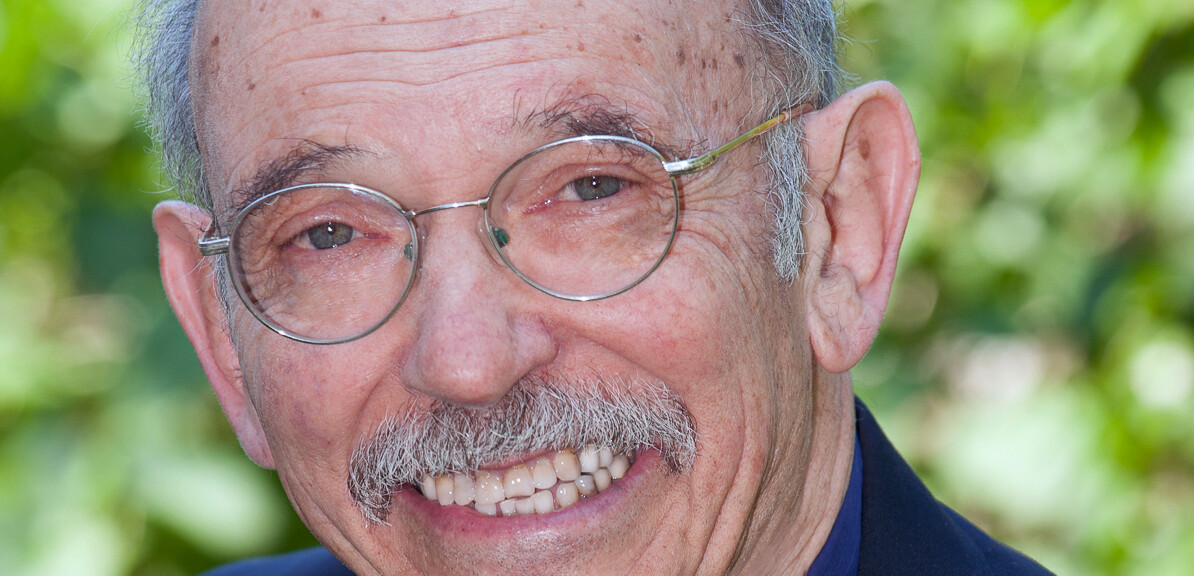
保罗-科恩(Paul A. Cohen)于 2025 年 9 月 15 日逝世,他是费尔班克中国研究中心(Fairbank Center for Chinese Studies)的长期顾问,也是韦尔斯利学院(Wellesley College)历史和亚洲研究荣誉教授伊迪丝-斯蒂克斯-瓦瑟曼(Edith Stix Wasserman)。享年 91 岁。
科恩教授著有广受赞誉的《在中国发现历史》(Discovering History in China)一书:他无疑是现代中国最重要的历史学家之一。他在哈佛大学获得历史学硕士和博士学位,曾是费正清(John K. Fairbank)和本杰明-施瓦茨(Benjamin Schwartz)的学生。他是美国第二代中国问题学者中的核心人物,常被认为促成了历史观从 “西方中心论 “向 “中国中心论 “的转变。
在费尔班克中心,科恩教授几十年来一直是我们社区的推动力,即使到了九十多岁,他仍会继续用他的智慧和风趣与我们打交道。
此外,科恩教授还继续为我们带来他的著作。2021 年,他出版了回忆录《我的中国史学之旅》(哈佛大学亚洲中心,2019 年):我的中国史学之旅》(哈佛大学亚洲中心,2019 年),该书全面记述了他自己的生活和学术工作方法,与读者分享(用他自己的话说):”当我逐渐了解历史学科时,尤其是当我逐渐对历史本身有了更深刻的理解,意识到一个与我自己如此不同的国家的历史并不像我想象的那样与世界截然不同时,我所感受到的兴奋和深深的喜悦”。
费尔班克中心的全体成员都将深切怀念保罗。以下是教师、朋友和同事们对保罗的回忆,以及他们在保罗漫长的职业生涯中与他共事的点点滴滴。
I owe Paul Cohen an enormous debt. Decades ago, as a junior at Wellesley, I was planning to apply for graduate study in medieval European history. Then I took Paul’s survey of Chinese history course—and that changed my life. I quickly shifted focus, and, with his and Helen Lin’s encouragement, went on to the study of China. Paul was a generous seminar teacher; he treated students as fellow scholars, expecting us to read carefully, think critically, and engage actively in debate. Remarkably, he had us critique one of his own book manuscripts, encouraging us to think that we, mere undergraduates, might also offer useful thoughts.
Throughout my graduate training he remained a valued mentor and, even after I left New England for work, I looked forward during my occasional returns to Cambridge to lunches and long and lively conversations with Paul. We talked about our ongoing projects; and the challenges that he made to my methods and reasoning often helped me reframe my approach.
Through the decades I have been teaching, I have also earned a great deal of undeserved credit from the fact that I was Paul’s student; my Chinese students, inspired by his Discovering History in China: American Historical Writing on the Recent Chinese Past and History in Three Keys: The Boxers as Event, Experience, and Myth, are very impressed when they learn I studied with him. In his scholarly work, he treated an impressive range of different topics in modern Chinese history: anti-Christian sentiment, late Qing reform, the Boxer rebellion, twentieth-century nationalism, etc. But in all these books—and in his penultimate work, History and Popular Memory—he revealed himself as much interested, more broadly, in how we think historically and how we use history in the present. The China field and the discipline of history, too, then also owe him an enormous debt.

Paul Cohen was a historian whose work on history and historiography has influenced a generation and more of scholars. His books influenced the way many of us thought about modern Chinese history, as did his frequent attendance at the lunch table of the Fairbank Center. Besides his good humor and willingness to discuss the details of Chinese history, Paul made a legendary chocolate cake!
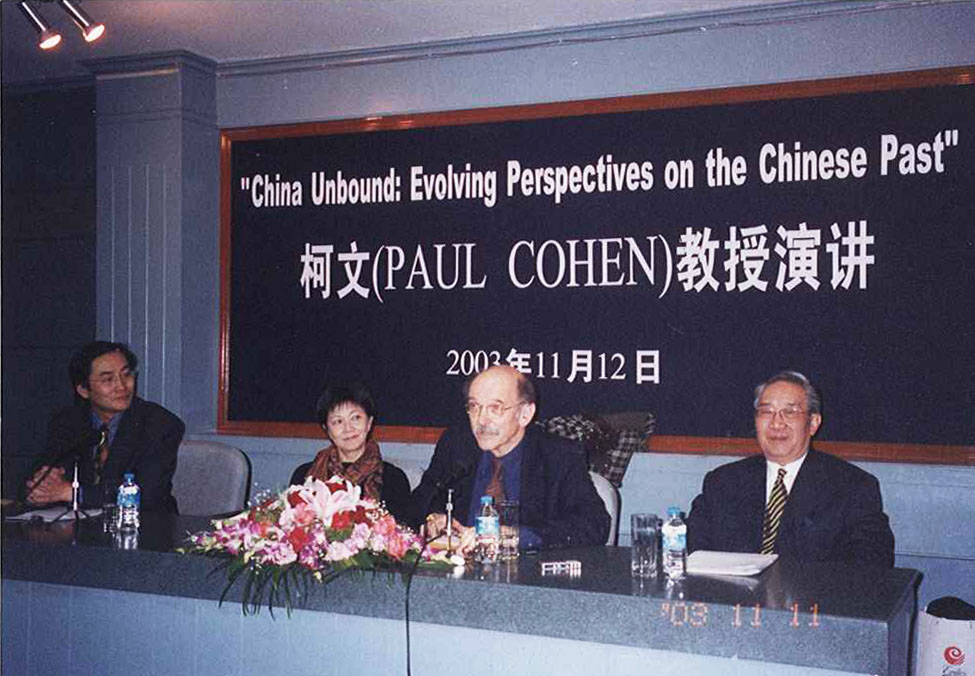
I first met Paul Cohen in the summer of 1975, when I attended a workshop he and John Schrecker organized and whose proceedings, Reform in Nineteenth-Century China, were published by the East Asian Research Center. In the preface, they explained that, whereas most workshops were closed, this one had been open to all scholars studying nineteenth-century Chinese reform. It was so open, in fact, that I, a Ming historian, was also welcomed. Roughly 50 historians assembled, two-thirds of whom were “advanced graduate students and younger scholars.” For two weeks, formal presentations and comments filled the mornings; informal gatherings and library research the afternoons. Having just completed my Ph.D., and having already read Paul’s first two books, I felt privileged to participate. The discussions were stimulating and the feedback on my own work helpful. More importantly, the shared experience spawned several enduring friendships, including that with Paul.
Paul seemed much my senior in 1975, but over time we grew closer. We interacted frequently at the lunch table at the Fairbank Center, in a short-lived study group (circa 1990) that tackled theoretical post-modern works, and as members of the Asia Center Publications Committee. We socialized outside such professional activities as well.
Paul was both unpretentious and had exquisite taste. This was immediately clear to me when he welcomed the members of the 1975 workshop to his home in Lincoln, MA, graced with pre-Columbian figurines and mid-century-modern Barcelona chairs. His taste was also evident in his refined but unostentatious dress and his keen interest in art and cooking. Many are those who have tasted Paul’s ginger cheesecake and plum torte. But it was his Grilled Duck Breast with Summer Cherry-Orange Sauce that best displayed his culinary skill. Hoping to cook it myself, I asked for the recipe, which he readily shared with me. It proved to be an intimidating document, heavily annotated by Paul and with a cross-reference to another cookbook. Such was his perfectionism and attention to detail.
I last saw Paul six weeks before his death. The occasion was at one of the many dinners that a small group of China scholars had taken turns hosting for over a decade—a group that Paul’s children called his “Dinner Club.” When we parted that evening, I felt an unprecedented tenacity in his goodbye hug. Little did I guess then that which he probably already knew: that his end was drawing near. He departed with the same decorum and warm considerateness that I had come to associate with him. I’ll miss him.
Paul Cohen was a scholar of wide impact in Chinese studies and throughout the history profession, one of the relatively few academic specialists on East Asia whose work was taken seriously by historians in virtually all fields and eras. Paul was gracious, witty, and supremely insightful in his teaching, his many writings, and his charming interactions with all who knew him. With his passing we’ve lost a rare and lofty intellect, yet we’ve gained so much from knowing him and learning from what he has taught us about China, history, and ourselves.
Paul was a historian of China whose scholarship earned admiration on both sides of the Pacific, yet what I remember most is the person behind the work—his kindness, quick humor, and the warmth he brought to everyday life. Few know he was equally talented in the kitchen, creating cakes, pastries, and a ginger cheesecake that was simply unforgettable. Baking was a delight he generously shared with those around him.
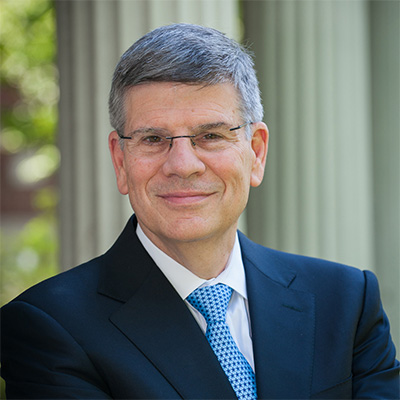
I first encountered Paul Cohen as an undergraduate when I was an exchange student, from Dartmouth, at Wellesley College. Paul taught modern Chinese history to a class of some 20-plus students, including two who would go on to doctorates and professorships in that field (Cynthia Brokaw and myself). It was an old-fashioned lecture class, with reasonably heavy reading, and in an era before today’s grade inflation, I received a B-plus.
I truly got to know Paul when I joined the Harvard faculty and had my office in the Fairbank Center in the old Coolidge Hall. Paul was a constant and generous presence at our many seminars and workshops and—above all—at our daily lunches with Ben Schwartz and Merle Goldman. In a place of big intellects and sometimes large egos, Paul was a colleague of modest demeanor and penetrating intelligence. A prolific and original scholar, he challenged dominant narratives in our field (including those of Fairbank) and wrote books of imaginative conception.
Both in Coolidge Hall and (after 2006) across the street at CGIS, Paul was the intellectual backbone of the Fairbank Center. He commented on papers and speakers, read dissertations and book manuscripts, and was an informal mentor to countless graduate students. Together with Merle, he oversaw our New England China Seminar that made a community of China scholars across six states.
The Fairbank Center may be located in Cambridge, but it gains strength from colleagues in and beyond Boston. No one added more than Paul Cohen, our comrade in scholarship and our friend.
Like so many others I am indebted to Paul Cohen for his generous advice and encouragement, his scholarly example, and his friendship. When I was in graduate school and, later, a young professor returning whenever possible to the Fairbank Center, Paul was always available for discussion and exchange of ideas. To me, it seemed that he embodied the academic excellence of the Fairbank Center.
I regarded Paul as a role model, a professor at a liberal arts college who nevertheless actively participated in academic life at the university level. His books — the pathbreaking China and Christianity (Harvard University Press, 1963), the timely Discovering History in China: American Historical Writing on the Recent Chinese Past (Columbia University Press, 1984), and the truly insightful History in Three Keys: Boxers as Event, Experience, and Myth (Columbia University Press, 1997) — were not just academic monographs but wonderful vehicles for undergraduate teaching.
Paul’s scholarship, leadership, and generous spirit have left an enduring legacy for his students, colleagues, friends, and admirers.
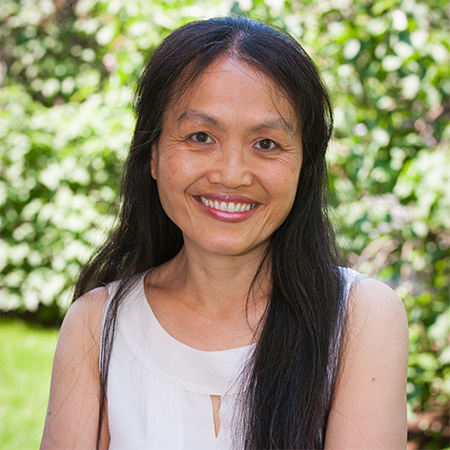
I remember running into Paul Cohen in the Harvard-Yenching Library when he was writing Speaking to History: the Story of King Goujian in Twentieth-Century China (2009). We had a long conversation on the representations of that figure in Chinese history and literature by the circulation desk. As always, Paul exuded joy and enthusiasm when he spoke about his research. He always maintained that having the time for research and writing was the great incentive for retirement. Scholarship kept him young. He was as engaged and as intellectually vibrant as ever at his ninetieth birthday party. We had many wonderful dinners together. One of the most memorable was the election night dinner of November 2008. We celebrated Obama’s victory with many toasts and Paul excitedly called Elizabeth, who was then in Hong Kong. Dinner conversation topics were typically far-ranging: history and politics here and in other parts of the world; the past, present and future of Hong Kong; being Jewish, being Chinese, and being American at different historical moments. Paul often served his ideas along with fabulous desserts. He was rightly proud of his ginger cheesecake, plum torte, and lemon bars. He was one of the kindest and most generous persons I have known. May his memory be a blessing.
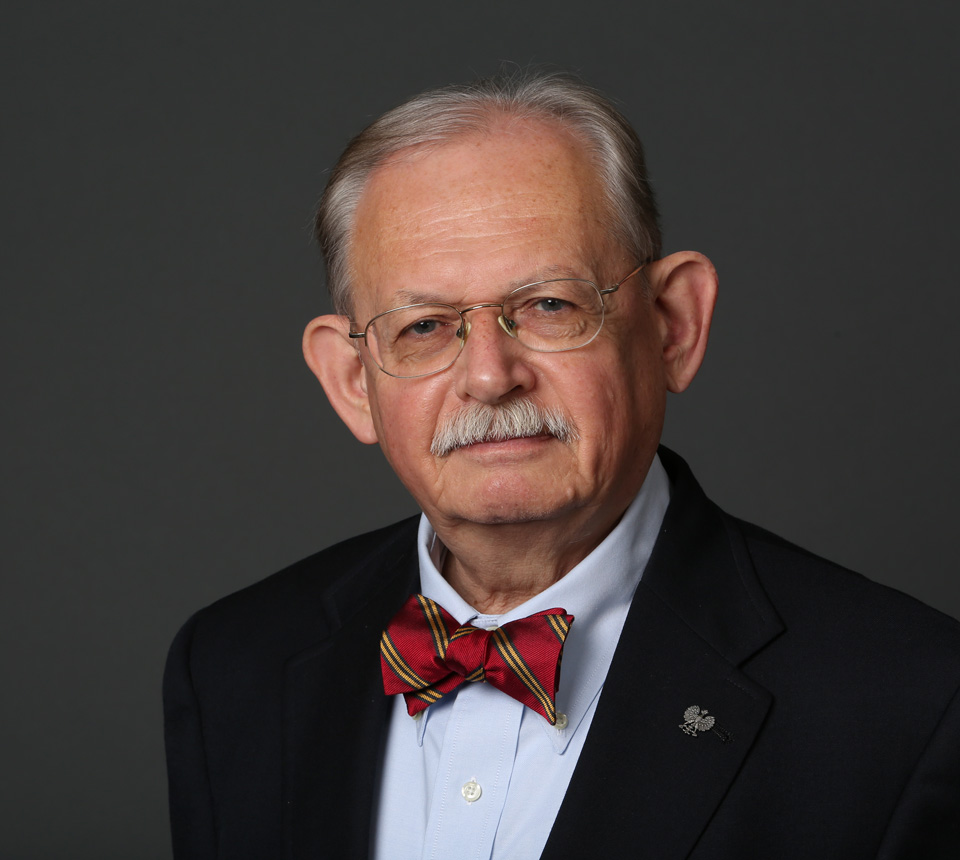
The two characteristics I always associate with Paul Cohen are his unassuming nature about his own scholarship, and that he was always welcoming and approachable.
We first met, as I recall, about 1969 or 1970, when my professor at the University of Michigan, Allen Whiting—where I was a graduate student—invited me to be among the Michigan grad students to attend a meeting in Washington D.C. that Henry Kissinger had invited him to. At that time, there was talk of the U.S. Government trying to open official channels of communication with China. I think Ezra [Vogel] was also at that meeting, as was Paul.
Since then, I have heard from a host of graduate students, Chinese, Japanese, and Americans, about how Paul’s books have taught them about historiography; how to conceive of and convey historical ideas. These comments have usually been told to me in highly reverent tones, one of great respect for Paul’s scholarship.
You’d never know of this veneration as you talked with Paul. I remember when we talked about the new book he was working on, Speaking to History: The Story of King Goujian in Twentieth-Century China. The story is that, when Goujian the King of Yue was defeated by the king of the rival state of Wu in 494 BCE, Goujian wanted to keep in mind the bitterness of his defeat as a way of motivating himself for revenge, so he kept a gall bladder in his room which he would lick every day to taste its bitterness. This has become the phrase in Chinese “Sleeping on brushwood and tasting the Gall” (臥薪嚐膽). It means to keep your spirit strong with a determination to fight back.
Paul told me that after publishing a lot of research about China, he unexpectedly encountered the story of King Goujian. It was an account he had never heard before, even though his Chinese colleagues all seemed to know the story. This led us to a conversation of how the “speakers of a native language” know things about their own culture that are taken almost as “common knowledge” by other native speakers but remain unknown to those of us outside that circle. It was a lesson for me that I’ve kept clearly in mind as I do my own research; I feel no hesitancy to ask my Asian “native speaker” colleagues all sorts of questions when I encounter these situations.
The most poignant moment for me with Paul was in 1998, when I returned from 20 years of living in Japan, and applied to become an Associate in Research at the Fairbank Center. I had been in the corporate world of international publishing and felt I had removed myself from the world of high scholarship as characterized by Harvard. I told Paul I was afraid the Fairbank Center would not accept my application. But Paul, true to form, smiled and told me that of course everyone at the Fairbank Center knew of me and that of course I would be accepted. I still recall that conversation clearly and the humbling gratitude I felt.
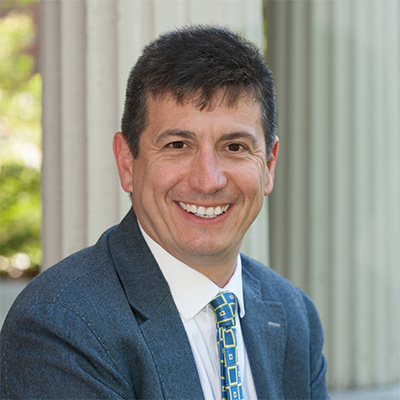
In the early years of the 21st century, a truly extraordinary group of senior scholars of China, all retired, made the Fairbank Center their intellectual home. Students and current faculty at Harvard and other schools in the area were all the beneficiaries of their generosity. I was completely star-struck when I first encountered these luminaries at the lunch table in the CGIS cafeteria. But in some ways, it was Paul Cohen who made the biggest impression, because Discovering History in China was one of those rare books that, decades later, I could still remember, almost viscerally, my initial experience of reading. Now here we were having lunch together!
On reading the early versions of A Path Twice Traveled, I urged Paul to tell us more about Paul Cohen the person. (According to the acknowledgements, so did many other people.) He accepted this suggestion, but perhaps not to the degree we all hoped. His geniality, humility, and sense of humor were, and remain, professional models for me. Though his scholarship had gravitas, one could never say of Paul that he took himself too seriously.
His quiet and always cordial manner, that deep gruff voice and warm smile, were sometimes hard for me to reconcile with his huge intellectual impact on the field and on me personally. I can still remember what it was like to read Discovering History for the first time, and I am reminded of Speaking to History, and Paul’s reflections on what he called “the problem of insideness versus outsidedness,” probably once a week. A casual comment at a faculty dinner—casual, but quintessentially Cohen, since it was all about the way my sources told stories as well as conveyed facts—completely changed my thinking on one of my own books. It was my great fortune to be his colleague and friend for more than 20 years.
Paul Cohen had just completed his manuscript when I arrived in Cambridge to begin my tenure as a member of the Harvard History Department. That year, the Center for East Asian Studies was hosting several historians of China from different institutions. In hallways and over lunch they discussed Paul’s new work, which would eventually be published as Discovering History in China: Western Writings on Modern Chinese History. China had recently granted access to foreign researchers, allowing them to conduct fieldwork and consult archives. So, for some, the China-centered approach that Paul was laying out seemed to be preaching to the choir. “Who will want to read the book?” one said in my hearing. But Paul’s book spoke to me. As a student of Vietnamese history, I was used to seeing it refracted through the lens of French colonial and American perspectives and made to provide grist for various political sympathies and scholarly theories that had not much to do with Vietnam. In the event, Discovering History in China became perhaps the best-known of Paul’s many books, a kind of vade mecum for new generations of graduate students.
His History in Three Keys: The Boxers as Event, Experience and Myth was also influential among historians of China and in the growing field of memory studies. As Paul was writing about the Boxers, there was a trend in academia to view rebels as proto-revolutionaries and to question the validity of archival sources as reflecting a hegemonic discourse of orthodoxy. History in Three Keys refocused debates about the Boxers, moving them in a different, more fruitful direction.
Later, Paul began to muse about the value of shame as a motivating factor. The end result was Speaking to History: The Story of King Goujian in Twentieth Century China.I mentioned to Paul that the story of Goujian, king of Yue (Viet) was part of the Vietnamese cultural heritage. Ordinary Vietnamese believe that in the “Great Proclamation of the Pacification of the Wu” of 1428, the Wu (Ngo) referred to the Ming, whose twenty-year occupation of medieval Vietnam had just ended, as descendants of Fuchai, the king of Wu and Goujian’s archenemy. “Sleeping on a bed of thorns and tasting bile” was and remains a familiar metaphor for enduring sacrifices for the sake of a great enterprise.
I do not miss the acrid smoke that filled the hallway of the old Fairbank Center until Paul was advised to give up pipe-smoking. But I miss Paul Cohen—the colleague, sounding board, and friend. And I miss Paul Cohen, fabulous cake-maker, whose cakes were the highlights of various gatherings of sinologists over the decades. The memory of the cake he contributed to Philip Kuhn’s sixtieth birthday still makes me smile.
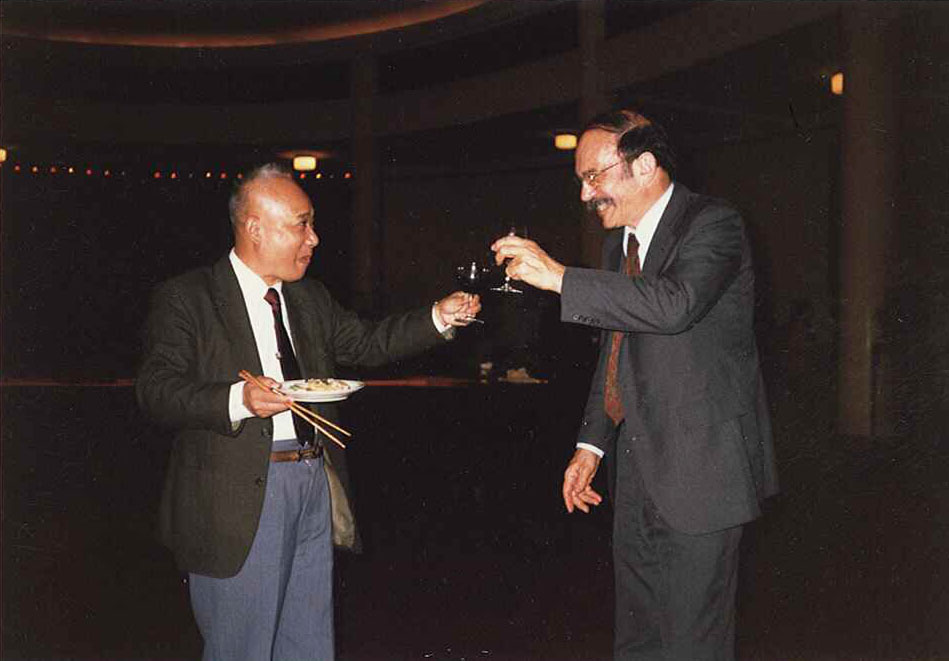

“…Paul also made a totally different sort of contribution: as a supportive mentor to people who admired his work and sought out his guidance. I feel very fortunate to belong in that category. More than forty years ago, Hue-Tam Ho Tai, whom I had had the good fortune to take a class with at Harvard while a student in the Regional Studies: East Asia program, did me the good turn of taking me by Paul’s office in the Fairbank Center to introduce me to him. She thought we should meet, since I had written a seminar paper for her on the Boxer Uprising and Paul was deeply interested in that topic. I was thrilled to meet him, having read and liked work he had done on foreign missionaries in Qing time (1644-1912) and Chinese intellectual of that era. I was nervous when we approached his door, but Paul’s smile put me at ease. I was disarmed by the warm way he greeted Tam (clearly a valued colleague to him) and by how he made it clear that he would be happy to chat about the Boxers or anything else on the mind of the master’s student in his early twenties she had brought to see him…”
摘自亚洲研究协会于 2025 年 9 月 23 日发表的瓦瑟斯特伦教授的悼词。
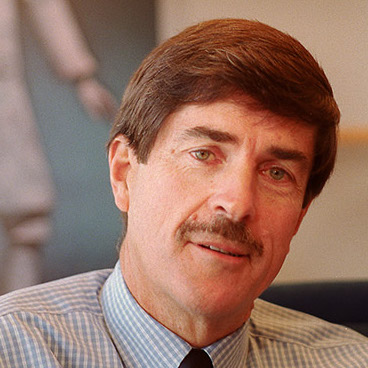
One of the features of the Fairbank Center for Chinese Studies that I always appreciated when I returned to Harvard as a faculty member in the Department of Sociology in 2000 (where I had done my graduate work and began to study China in the late 1960s) was the fact that the Center’s activities were enriched not only by the talented students and faculty members of Harvard itself, but also by the active involvement of China scholars from the wider Boston area, and that this involvement continued even after they had retired from teaching, as in the cases of colleagues such as Merle Goldman and Paul Cohen.
I always found Paul’s thoughtful comments and questions in Fairbank Center China talks and meetings very insightful, but given our differences in disciplines and time focus (very little of my work focuses on China before 1949), our relationship was mostly one of friendship rather than substantive intellectual exchanges. But Paul played a key role in my life after the death of my mentor, colleague, and friend Ezra Vogel, in 2020, when I engaged in discussions with many others about how best to honor Ezra. From those discussions, a consensus emerged that it didn’t make sense to organize a festschrift conference of scholarly essays by Ezra’s former students, which would result in a volume that would sit on library shelves mostly unread. Fortunately, we had an alternative model to consider. When John Fairbank had died in 1991, Paul and Merle led an effort to collect very brief reminiscence essays from a wide range of people whose lives Fairbank had influenced, within academe and far beyond. The collection of reminiscences they collected was published in 1992 in a volume entitled Fairbank Remembered. A consensus emerged that we should follow the template of that earlier volume in order to honor Ezra. And that is where Paul’s key role came in.
My eventual collaborator in this effort, Mary Brinton—a sociologist specializing on Japan—and I were concerned about how to contact potential contributors to a volume of brief reminiscences involving Ezra, and particularly how to get them to agree to follow the strict parameters we wanted to enforce: that they should focus on a particular experience with Ezra, rather than their entire career of interactions with him, and that they could not exceed 1000 words. I contacted Paul for guidance, and as a good historian, it turned out he had retained from 30 years earlier copies of the letters he and Merle had used to solicit reminiscences for the volume honoring Fairbank. He dug those letters out and, given that they were from a pre-email era, he Xeroxed them and mailed the copies to me. Mary and I followed the example of his solicitation letters closely, and the result was that, in 2022, we were able to publish Remembering Ezra Vogel, a volume containing 155 personal accounts of the many diverse individuals influenced by Ezra. And, of course, Paul contributed a very thoughtful essay for our volume, recounting his relationship with Ezra, which began in 1965, when he returned to the Boston area to teach at Wellesley and Ezra was just beginning his career at Harvard as the sociological expert on China and Japan. These two volumes, Fairbank Remembered and Remembering Ezra Vogel, can be regarded as companion tribute volumes honoring two towering leaders of China studies at Harvard, and Paul played a key role in both of them.
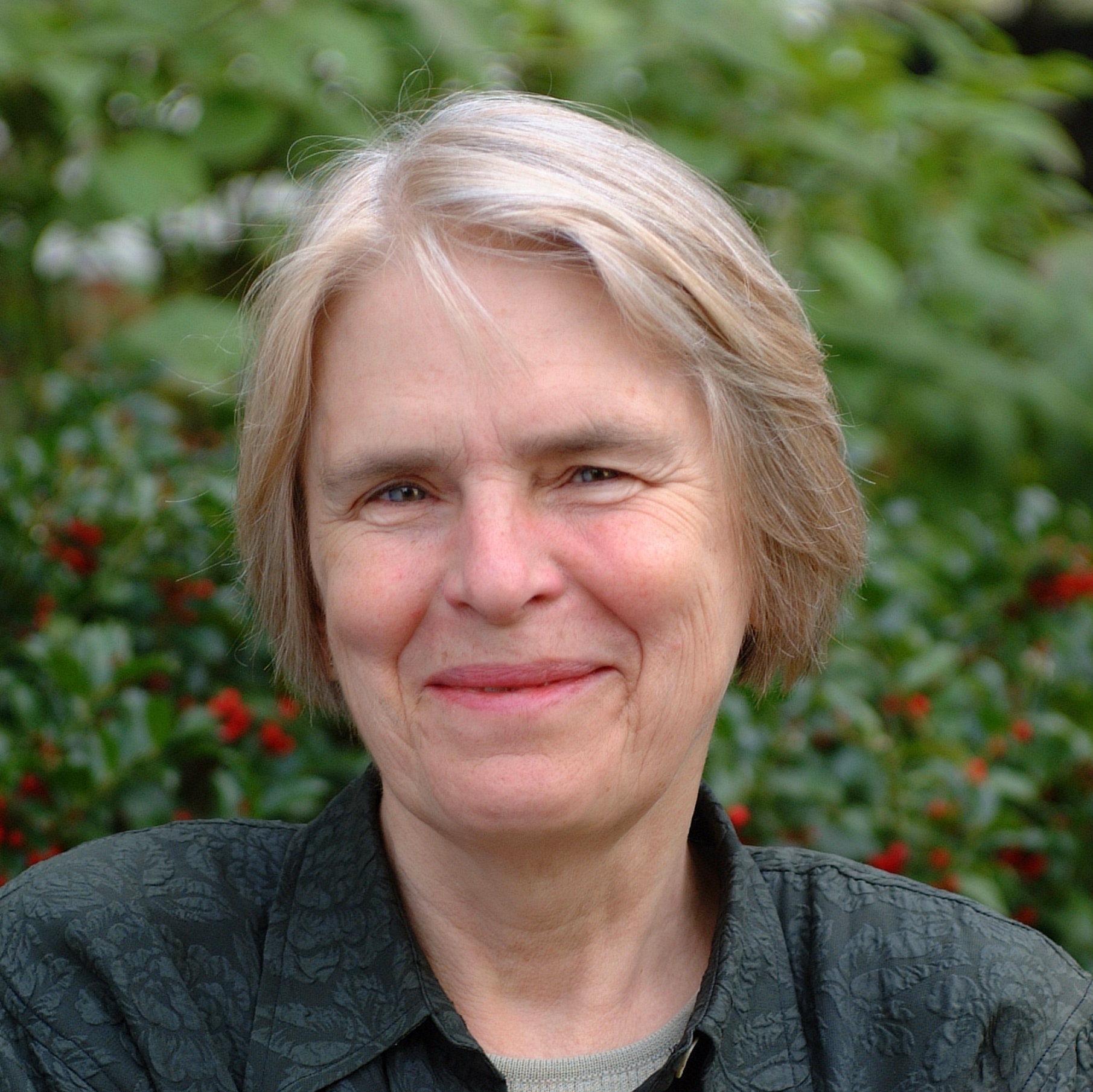
Paul Cohen was a friend. We didn’t start out that way. Before the friendship emerged, there were two other stages. The first began at the Fairbank Center, where I attended as many of his book-launching seminars as I could. They were always grand events. I would go home filled with new ideas but also impressed at the thoughtful and open-minded dialogues he held with his audiences. China and Christianity and History in Three Keys are the two I best remember.
The second stage caught me by surprise. It revolved around a question: whether I might accept a job at Wellesley College, a plan for which Paul advocated informally. Discussions began in 2006. The decision was difficult. I was happily working at Wesleyan University, but I had attended Wellesley as an undergraduate and had retained close ties with Cambridge, so the prospect of moving to the Boston area was tempting. Furthermore, the job sounded interesting. Paul heard me out and was persuasive. One year later, I took the job.
The friendship was never one-to-one. Rather, it developed in a group setting. The group met for dinner several times a year. It had taken shape before Covid, but it gained momentum during the Covid years, when social options were so few but so precious. The dinners were rich in discussion. Both Paul and Elizabeth played leading roles. China was sometimes a topic, though not always. It was there that I learned of Paul’s outstanding skill with desserts, especially chocolate desserts. All were beautifully crafted as well as delicious. Who knew? It was always a treat when they appeared. The group continues to this day. Our most recent meeting was in early August of this year. At meetings, Paul always wanted a report on how things were going at Wellesley. He also shared much about his life and his family. As in the discussions of ideas at the Fairbank Center and our back and forths over the Wellesley job, he listened well. The group was honored to be included in the family celebration of his ninetieth birthday in June of 2024.
From his books to his desserts, from his intellectual leadership to his more personal moments, Paul’s friendship was a gift that I never expected. Indeed, it took me a while to identify it as a friendship, because it never transcended the group setting. But a friendship it was, not just with me but with all the other members. I think of it with gratitude, nostalgia, and even a touch of wonder, now that he is gone.