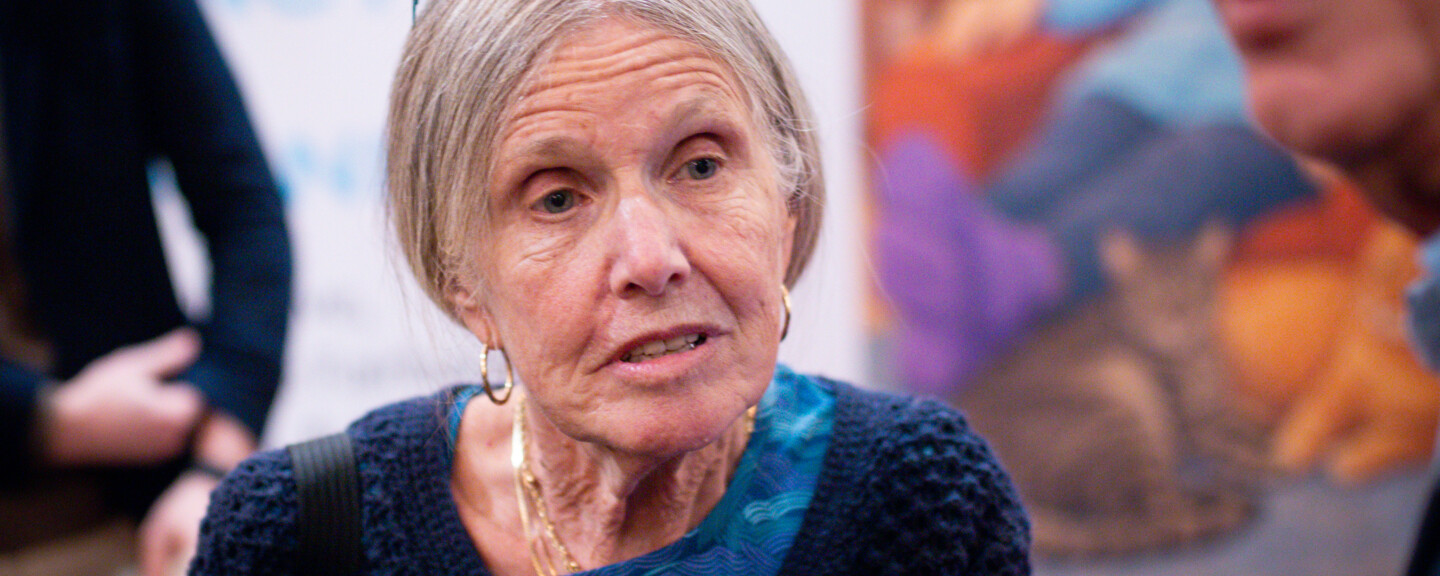

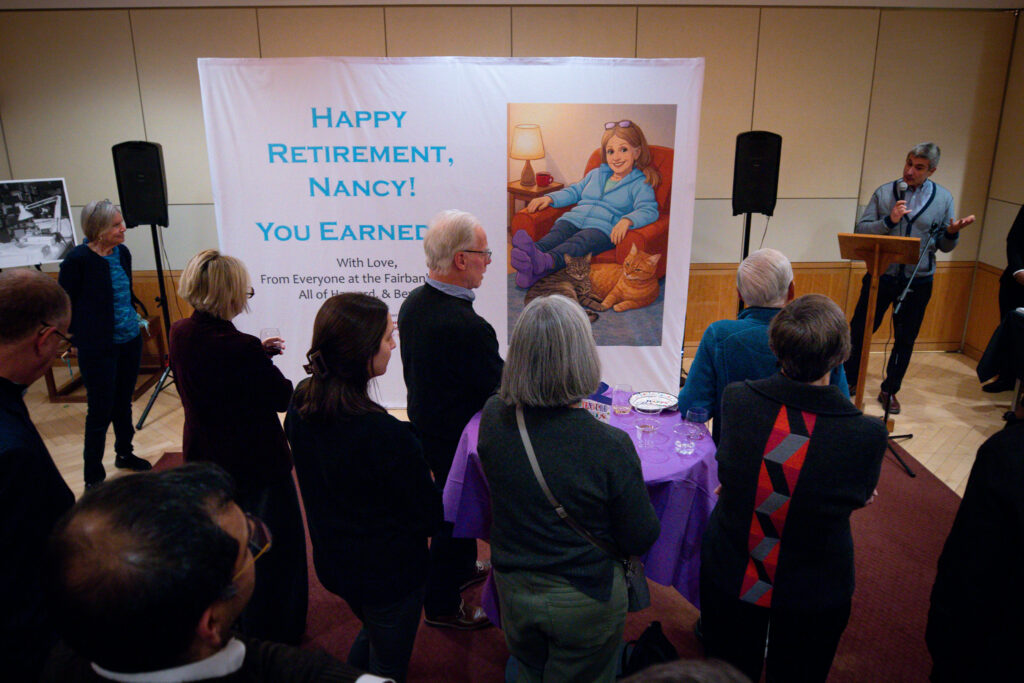
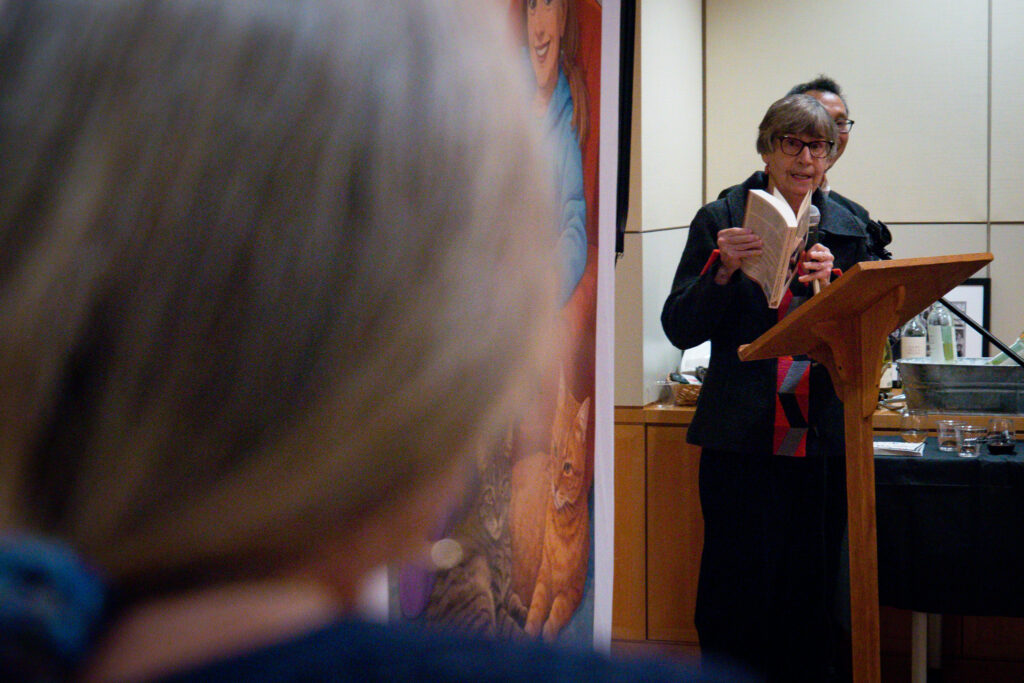
After fifty-one years of service to the Fairbank Center for Chinese Studies as Librarian of the H.C. Fung Library, Nancy Hearst has retired. Nancy has been a steady, expert presence for multiple generations of students, faculty, visiting scholars, and researchers at Harvard. She has spent over fifty years honing her craft – using her almost-photographic memory to connect people to sources, curating a unique collection of hard-to-find social sciences materials on contemporary China, and, in her own inimitable fashion, becoming an irreplaceable source of good humor and wisdom for the Chinese studies community at Harvard and beyond.
Graduating with a major in French Literature seems an unlikely start for someone who would become a pillar in the China studies community. While working at MIT and taking Chinese language courses at Harvard in 1974, Nancy was personally selected by Professor Ezra Vogel to become the Librarian of a growing collection of research materials owned by the then-East Asian Research Center. (Vogel asked her to make a commitment to stay with the job for at least a year.) At the time, the noncirculating collection comprised, among other items, Professor John King Fairbank’s personal books on China. As the first formal librarian, Nancy was tasked with the daunting challenge of expanding these holdings into a premier collection of social sciences material on contemporary China and the rise of the Chinese Communist Party.
Over the years, Nancy played a central role in curating and acquiring the unmistakably unique collection at the Fung Library. Since the 1980s, Nancy has made trips either once or twice a year to Beijing to acquire books, in an acquisition process that former Fairbank Center director Roderick MacFarquhar described as “guerilla book shopping.” She relied also upon her seemingly endless network of “guanxi”—friends, colleagues, vendors, suppliers, and other contacts in China Studies across the world—to acquire rare and valuable material. Whether it was a long-out-of-print work requested by faculty or a self-published memoir with a highly limited print run, Nancy could be counted on for her resourcefulness and determination to track it down. Her work also extended into public-facing stewardship of the collection, such as welcoming notable donations from well-known supporters —like the Fung Library’s Chinese calligraphy collection (donated by Li Honglin, an influential intellectual and former senior official who played an instrumental role in China’s reform and opening up.)
Nancy’s contributions have been both scholarly and editorial. Over the course of her tenure at the Fung Library, she played a pivotal role in bringing the Fairbank Center’s landmark publication series Mao’s Road to Power to completion. Originally the endeavor of Professor Stuart Schram, the monumental ten-volume project—translations of Mao Zedong’s writings from 1912 to 1949—was passed on to then–Fairbank Center director Roderick MacFarquhar in 1989. After decades of collaborative translation and editing across multiple editorial teams, when Professor MacFarquhar passed away in early 2019, his last wish for Nancy was that she would finish the final two volumes. Hearst ultimately took the reins for the final stretch, working closely with the late Professor Joseph Fewsmith to organize, edit, annotate, and proofread the final two volumes (covering August 1945–June 1947 and July 1947–October 1949). Published by Routledge in February 2023, Volumes IX and X marked the completion of a more-than-30-year endeavor and stand as a testament to Hearst’s scholarly stewardship and deep commitment to preserving—and expanding access to—the historical record.
Nancy’s dedication and commitment to the center is more than apparent from her tireless efforts, day-after-day, for more than 50 years ensuring that the Fairbank Center continue to serve students, scholars, and faculty to the highest degree. Her work spans the directorship of 15 out of the 16 directors of the Fairbank Center at Harvard and has taken place in four separate locations across three different buildings. An official count puts the library’s current collection at over 50,000 items. However, her contributions are not limited to making the library the one-of-a-kind institution it is today. They are also reflected in the generations of China scholars to whom she has become an indispensable resource and a trusted friend. It is no wonder Professor Ezra Vogel has said that one of the best decisions he ever made for the Center was hiring Nancy Hearst as Librarian.
In recognition of her lasting contributions to the Fairbank Center community, we are also pleased to announce that Nancy Hearst is being named a Fairbank Center Associate. We look forward to continuing our connection with Nancy in this new capacity, and we congratulate her warmly on her retirement and all that she has accomplished.

For decades, Nancy Hearst has personified the spirit of the Fairbank Center, in both her dedication to scholarship and in her nurturing of individuals. By the time that I arrived at Harvard as a student 35 years ago, Nancy was already a legend. The library back then was housed in much tighter, packed quarters in the old Coolidge Hall, and I would spend hours down there going through materials in my job as a research assistant. For us students back then, Nancy was an intimidating, but invaluable, resource. One quickly learned that if you didn’t know the answer, you could go ask Nancy, and she inevitably would be able to direct you. But you also didn’t want to waste her time, as her office was always full of visitors coming in and out. And of course, you shouldn’t be too loud – lest you disturb the important work taking place in trying to understand where China was headed after reforms restarted in the early 1990s.
Fast forward many years later, and as director, I truly grew to appreciate the impact that Nancy has had on our field of Chinese Studies. I saw firsthand how Nancy’s guidance transformed the work of so many prominent scholars in our field. I learned of the connections that Nancy helped nurture between people and in making people feel welcome in our community. And I also saw the impact that Nancy had on so many individuals who would then go on to serve outside of academia as well, in fostering U.S.-China relations. In short, what I learned was that when many people said that they were coming to visit the Fairbank Center, what they really meant was that they were coming to visit Nancy Hearst. Her lifetime of work and dedication to not only the library but more importantly to people has played an invaluable role in shaping the Fairbank Center into the institution that it is today.
— Mark Wu, Henry L. Stimson Professor of Law, Harvard Law School; Director, Fairbank Center for Chinese Studies
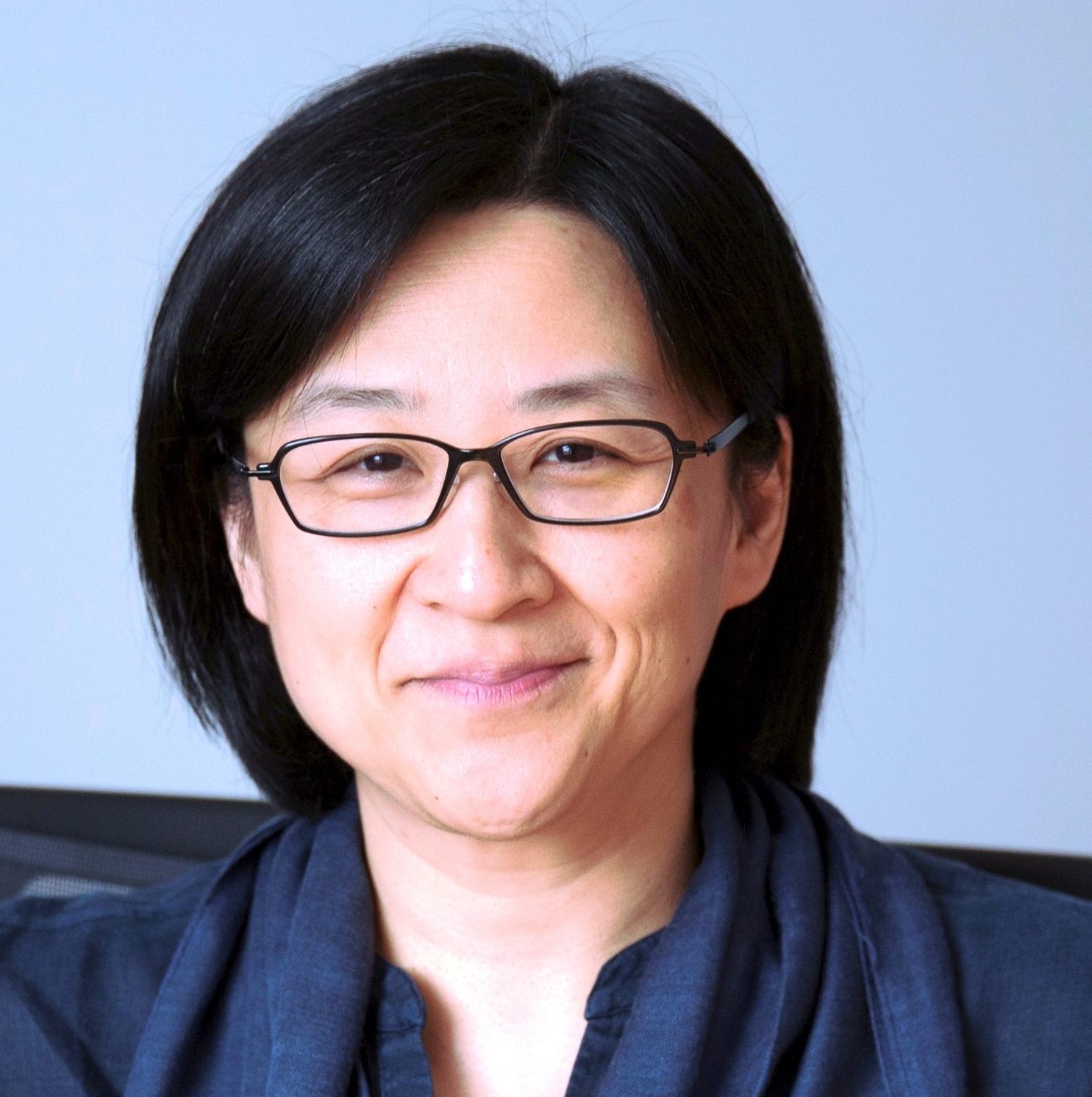
Although I did not have the opportunity to work closely with Nancy over many years, I came to deeply appreciate her during my time as Acting Director of the Fairbank Center in 2020–2021. It was an unusually isolating period, with most activities online, yet Nancy reached out to me several times with thoughtful messages of support. I especially remember when we met in person and she brought along a few new acquisitions she thought I would find interesting, including China’s Gilded Age by Yuen Yuen Ang. I found that gesture deeply touching—it reflected her attentiveness and generosity.
In a year when much of our community was physically apart, the enduring strength of the Fung Library—and the scholarly community it supports—was especially evident. That strength reflects Nancy’s decades of dedication: her care in building and curating an extraordinary collection, her deep knowledge of its holdings, and her quiet but profound support for generations of scholars. I have heard, time and again, how welcome she made visiting researchers feel, and how her guidance often opened paths to sources that might otherwise have remained undiscovered. Her work has enabled and enriched an immense body of research, often behind the scenes but always at the core. For this, and for her steadfast commitment to the Center’s mission, I offer my sincere gratitude and warmest congratulations on her retirement.
— Winnie Yip, Professor of the Practice of Global Health Policy and Economics; Director, Fairbank Center (2020 – 2021)
Japan and Taiwan share a charming system of granting certain people official status as “Living National Treasures” (人间国宝), colloquially abbreviated in Taiwan as guobao. Nancy Hearst is the Fairbank Center’s guobao (Living Center Treasure just doesn’t flow off the tongue as well). I don’t use the term lightly. Of course, guobao have achieved the highest level of mastery of a field, but the honor is not about recognizing celebrity. It is about honoring those who preserve and transmit heritage to future generations. Nancy is best known for her public role in building the extraordinary Fairbank Center Library collection over the course of a half-century. But she is also our guobao because of the role she plays in supporting the work of generations of scholars. She has served as copy editor and proofreader for countless important works of scholarship, improving the work not just of Chinese speakers but native speakers of English as well. She has provided support, sometimes critical support, to countless Chinese colleagues. Facilitating their research on sensitive topics that might not be possible to study in China is only part of this support. And she has made important contributions to scholarship in her own right, especially by editing the final volumes of Mao’s Road to Power. To hear her tell it, she did this to fulfill her commitment to another Fairbank Center Director, Rod MacFarquhar. But scholars will also recognize this work as a huge contribution to the study of Mao Zedong. It’s good to know that even as she steps away from her role as head of the library, she will continue to play the many other roles that make her our guobao.
—Michael A. Szonyi, Frank Wen-Hsiung Wu Memorial Professor of Chinese History; Director, Fairbank Center (2016 – 2022)

It is often said that an institution is its people. It stands to reason, then, that an institution committed to excellence must have excellent people. NancyHearst is proof of the essential truth of this proposition. For decades, she has dedicated herself to advancing the mission of the Fairbank Center by supporting the research of hundreds of scholars, her office a Mecca for anyone seeking guidance on how to navigate the sources that would reveal to them the path forward to knowledge and understanding of the history and politics of contemporary China. Though not a single monograph lists her as author, Nancy’s contributions to the field are enormous, documented in an enormous binder holding scores and scores of acknowledgments and in the hearts of the generations of academics who have benefited from her knowledge and insight. The Fairbank Center owes much of its excellence to her tireless devotion to scholarship and librarianship.
—Mark C. Elliott, Mark Schwartz Professor of Chinese and Inner Asian History; Vice Provost for International Affairs; Director, Fairbank Center (2010 – 2011 (acting), 2013 – 2015)
Since I was only acting director of the Fairbank Center for one year, while Bill Kirby was on leave, I would like to pay tribute to Nancy Hearst’s vital role in the Fairbank Center by citing the experiences of a former director who is no longer with us, Ezra Vogel. After Ezra died in 2020, my sociology colleague Mary Brinton and I collected brief reminiscences of Ezra from dozens of his former students, colleagues, and friends which we published in 2022 as Remembering Ezra Vogel. One of the nicest essays was contributed by Nancy. She noted that whenever Ezra began a new book project, he would contact her for help locating all the documentary evidence he wanted to read to prepare. He would send Nancy lists of sources he wanted her to track down in the Fung Library and put in a carrel for him to read through. But Ezra had so many friends that, whenever he went to the library, he would be constantly interrupted by people wanting to say hello (and much more). Eventually she and Ezra developed a new approach, in which he would send Nancy lists of sources he wanted to read through, and she would send them over to 14 Sumner Road by bookmobile, so Ezra could read through them uninterrupted by his many friends. It is obvious to me that Nancy deserves major credit for the impressive scholarship record Ezra compiled in his many years at Harvard.
—Martin Whyte, John Zwaanstra Professor of International Studies and Sociology, Emeritus; Director, Fairbank Center (2007 – 2008)
Nancy Hearst joined Harvard when Gerald Ford was president, and Mao Zedong was still alive. When they had a summit in 1975, Mao was almost impossible to understand, but he said something that was translated loosely as “I have an appointment to see God soon.” And Gerald Ford, being a very polite Midwesterner, thanked the Chairman for his time and said, “I don’t want to keep you from your next appointment.”
This is one of the few stories of modern Chinese history that is not in Nancy’s collection. She joined us before there was a Fairbank Center, and she has been the backbone, the personality, the personification of serious research on modern and contemporary China. The Fairbank Center’s collection exists because Nancy has guided the ongoing strength of the extraordinary collection of modern contemporary China in the Fung libarary. She has assisted generations of Harvard faculty in their work, but even more so generations of our students who have worked on important issues of modern and contemporary China. The Center would not be what it is without the extraordinary, indefatigable work of Nancy Hearst.
—William C. Kirby, T. M. Chang Professor of China Studies; Spangler Family Professor of Business Administration; Harvard University Distinguished Service Professor; Director of the Harvard China Fund; Director, Fairbank Center (2006 – 2013)

It was my honor to serve as Director of the Fairbank Center from July 2002 to June 2005, during its temporary exile to Central Square, when its old accommodations were torn down and CGIS North and South were constructed but the planned underground passageway between the two was struck down. At Central Square, Nancy and the library were housed on the floor below that of the offices of faculty and fellows, its location symbolizing the fundamental position in the Center of her and the books. One of the events that struck me most in my early days as director was the comments of one of the Chinese visitors at the time who expressed not only his utter surprise at the richness of the library, but also his even greater surprise that all these often rare and internal publications were freely accessible. Many of us may have believed that the growth of online facilities might make such a library an antique, but the continuously increasingly internet control in the PRC has clearly shown the enduring value of such a black and white paper collection as has been built up by Nancy and her staff over the years by utilizing her great personal network inside and outside China. During my term as director, much time was taken up by negotiations with the Harvard University Library System about a full incorporation of the FC library in that system, and while I was open to the advantages of such a move, I am happy that Nancy consistently insisted on the peculiar character of FC collection and its functions, and eventually financial constraints on the other side ensured the continued independence of the FC library. Nancy was not only an excellent librarian. She also was an efficient and meticulous research assistant and copy editor. Perhaps most of all, she was extremely helpful to all visitors of the FC, assisting them not only in finding their way about the library, but also about the FC, the University, and Cambridge, greatly enhancing the value and the pleasure of their stay.
—Wilt Idema, Professor of Chinese Literature, Emeritus; Director, Fairbank Center (2002 – 2005)
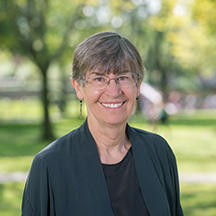
For the past half-century, Nancy Hearst has been the unsung “core” (核心) of the Fairbank Center. She has helped countless students and colleagues from all over the world by obtaining hard-to-access primary materials for their research, expertly editing their writing, and connecting them with one another. When German political scientist Sebastian Heilmann and I co-edited a collection of conference papers entitled Mao’s Invisible Hand: The Political Foundations of Adaptive Governance in China in 2011, we dedicated the volume to Nancy for her editorial and scholarly contributions. The choice of “Invisible Hand” as the title of the volume was most obviously a reference to Adam Smith’s metaphor for the hidden operation of a free market in a capitalist economy, suggesting that Mao Zedong’s revolutionary legacy plays a similarly important if obscure role in the operation of contemporary Chinese politics. But the term “Invisible Hand” might also be understood as a reference to Nancy Hearst herself. Nancy’s fifty years of self-effacing, behind-the scenes contributions to the operation of the Fairbank Center have been more valuable in securing its preeminence in Chinese studies than the actions of any of its many, more visible directors.
—Elizabeth J. Perry, Henry Rosovsky Professor of Government; Director of Harvard-Yenching Institute; Director, Fairbank Center (1999 – 2002)
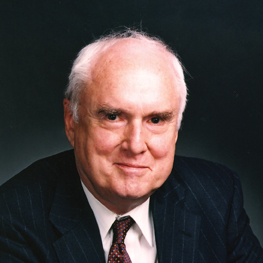
Nancy has every reason to be proud of her career with the Fairbank Center. Her core achievement, of course was the China collection in the CGIS library. She not only collected the China related books in the library, among many other things, I also often sent students doing their theses to her for guidance. Nancy was an excellent librarian, but she was also much more, a skilled professional China specialist much like the rest of us connected to the center and better than most. She cannot really be replaced and will be very much missed.
—Dwight H. Perkins, Harold Hitchings Burbank Research Professor of Political Economy, Emeritus; Director, Fairbank Center (1975 – 1976 (acting))