Foreign Relations and Security | 外交和安全
English (英文) | Chinese (中文)
As China’s economic, military, and diplomatic power has grown, so too has the urgency of a central question in world affairs: what does China want?
The answer is neither simple nor uncontested. Interpretations of China’s foreign and security policy vary widely, highlighting factors such as power shifts, regime survival, nationalism, ideology, historical memory, and leadership. This portal brings together rigorous historical and social scientific research to help readers evaluate competing explanations for change and continuity in China’s foreign and security policy under Xi Jinping.
Interview | Professor Alastair Iain Johnston
Alastair Iain Johnston, Governor James Albert Noe and Linda Noe Laine Professor of China in World Affairs, Government Department, Harvard University
Highlights from the Critical Issues Confronting China Lecture Series
Framing the Issue
Lectures
Breakneck: Can China Outcompete the U.S. on Innovation?
Critical Issues Confronting China Lecture, Fall 2025
Dan Wang, Research Fellow, Hoover Institution, Stanford University
The Influence Game: What Does China Really Want?
Critical Issues Confronting China Lecture, Fall 2025
Zenobia T. Chan, Assistant Professor, Department of Government, Georgetown University
The Dragon Roars Back: Xi’s Power Concentration and Foreign Policy Implications
Critical Issues Confronting China Lecture, Spring 2025
Suisheng Zhao, Professor and Director, Center for China-U.S. Cooperation, Josef Korbel School of International Studies, University of Denver
Avalanche Decoupling: Economic Contingency Planning for Taiwan Crisis
Critical Issues Confronting China Lecture, Fall 2024
Hugo Bromley, Postdoctoral Research Associate, Centre for Geopolitics, University of Cambridge
Eyck Freymann, Hoover Fellow, Stanford University
Bureaucracy and Blunder: How Politics Shapes China’s Policymaking
Critical Issues Confronting China Lecture, Fall 2024
Tyler Jost, Assistant Professor of Political Science, International & Public Affairs and Watson Institute Assistant Professor of China Studies, Brown University
More from Us
-
Interview With Oriana Skylar Mastro | Upstart Strategy: How China Competes Differently With the U.S.

-
China and the World Program 20th Annual Conference | Panel 4: What Chinese Leaders Are Learning from Recent Wars

-
China and the World Program 20th Annual Conference | Panel 3: Prospects for the Belt and Road Initiative
-
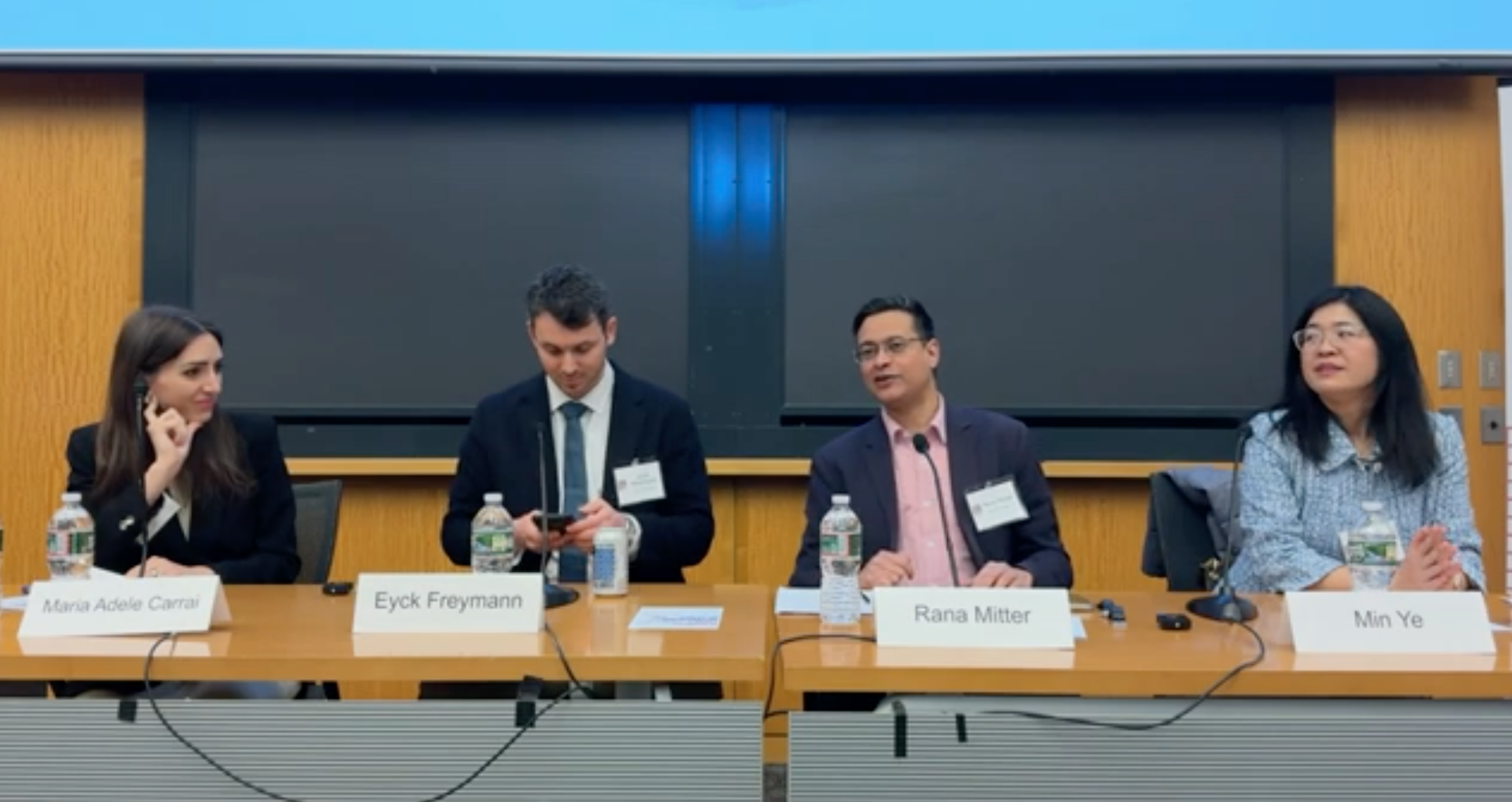
China and the World Program 20th Annual Conference | Panel 2: Foreign Policy Implications of the PRC’s Economic Slowdown
-
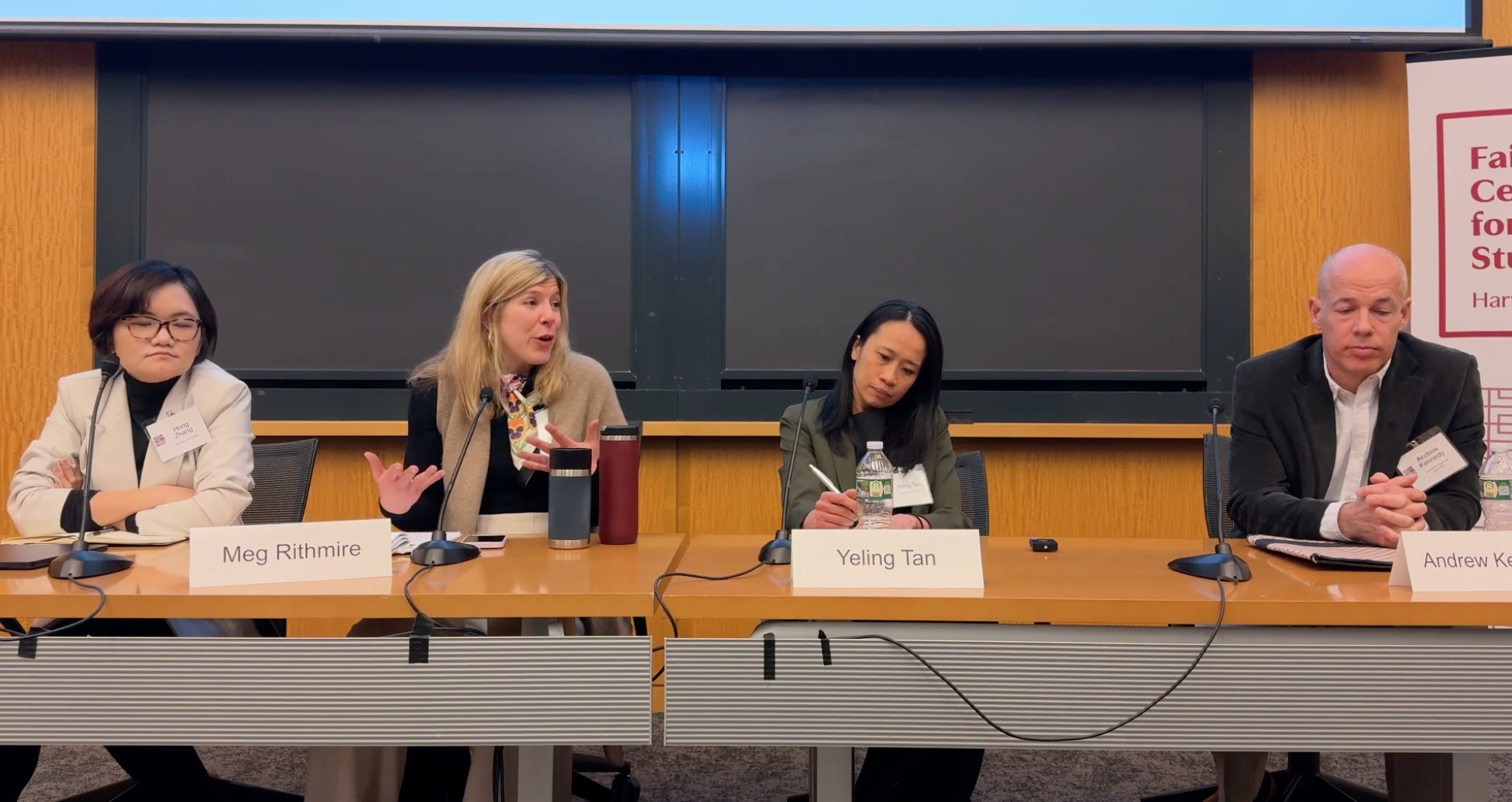
China and the World Program 20th Annual Conference | Panel 1: Measuring China’s “Influence” in International Affairs


Our Experts
William P. Alford
Harvard Law School
Susan Greenhalgh
Department of Anthropology, Harvard University
Daniel Koss
Department of East Asian Languages and Civilizations, Harvard University
Ya-Wen Lei
Department of Sociology, Harvard University
Rana Mitter
Harvard Kennedy School
Elizabeth J. Perry
Department of Government, Harvard University
Meg Rithmire
Business, Government & the International Economy (BGIE) Unit, Harvard Business School
Robert S. Ross
Boston College
Anthony Saich
Harvard Kennedy School
Michael A. Szonyi
Departments of East Asian Languages & Civilizations and History, Harvard University
Yuhua Wang
Department of Government, Harvard University
Mark Wu
Harvard Law School
More to Think About
“The Institutional Origins of Miscalculation in China’s International Crises,” by Tyler Jost, International Security (2023)
Why We Should All Read It: This article explains when China is prone to miscalculate in international crises. Through systematic analysis of China’s crisis behavior over time, Jost argues that China is most likely to miscalculate when its national security institutions distort or block information flow between top leaders and the diplomatic, military, and intelligence bureaucracies. One broader contribution of the article is that Jost challenges simple “personalist dictator” explanations for China’s foreign-policy blunders, instead turning attention to how China’s institutions and how its leaders manage them.
“Security Without Exclusivity: Hybrid Alignment Under U.S.-China Competition,” by Sheena Chestnut Greitens and Isaac B. Kardon, International Security (2025)
Why We Should All Read It: This article questions the belief that the U.S. and China are locked in a new Cold War and other countries must inevitably choose sides. Using a series of case studies, it argue that the U.S. and China provide different kinds of security and it often makes sense for small and middle powers to pursue non-exclusive forms of cooperation with both great powers.
“China’s Party-State Capitalism and International Backlash: From Interdependence to Insecurity,” by Margaret M. Pearson, Meg Rithmire, and Kellee S. Tsai, International Security (2022)
Why We Should All Read It: This article traces China’s shift from ordinary state capitalism to party-state capitalism, a system in which the Chinese Communist Party privileges corporate political loyalty and embeds itself more deeply in China’s firms, finance, and strategic technology sectors. The authors argue that this transition has triggered an economic security dilemma, whereby China’s efforts to secure regime survival and technological self-reliance generate foreign backlash against Chinese firms, which in turn reinforces Beijing’s own insecurity and further securitization.
“The Limits of Liberalization: WTO Entry and Chinese State-Owned Firms,” by Yeling Tan and Christina L. Davis, International Studies Quarterly 67(3) (2023)
Why We Should All Read It: This article challenges the conventional wisdom that state ownership in Chinese firms limited the liberalizing effect of the WTO. Drawing on detailed data comparing state-owned and private firms from 1993 to 2012, the co-authors show that both sectors largely became more commercially oriented after China joined the WTO. However, strategically important state-owned enterprises protected by industrial policy remained insulated from liberalizing pressures. In doing so, the authors reveal that, with the exception of strategic SOEs, China’s integration into the global economy had a more liberalizing effect on firms in China than is commonly assumed.
Banking on Beijing: The Aims and Impacts of China’s Overseas Development Program, by Axel Dreher, Andreas Fuchs, Bradley Parks, Austin Strange, and Michael J. Tierney (Cambridge University Press, 2022)
Why We Should All Read It: This book offers one of the most systematic examinations of Chinese development finance to date. Across nine chapters, it explores the motivations and mechanisms behind Beijing’s transition from ‘benefactor’ to ‘banker’ with respect to infrastructure finance in the developing world. Through advanced data collection and rigorous statistical analysis, the book traces the important political and economic consequences of Chinese lending, ultimately revealing how Chinese practices are neither pure predation nor wholly altruistic.